
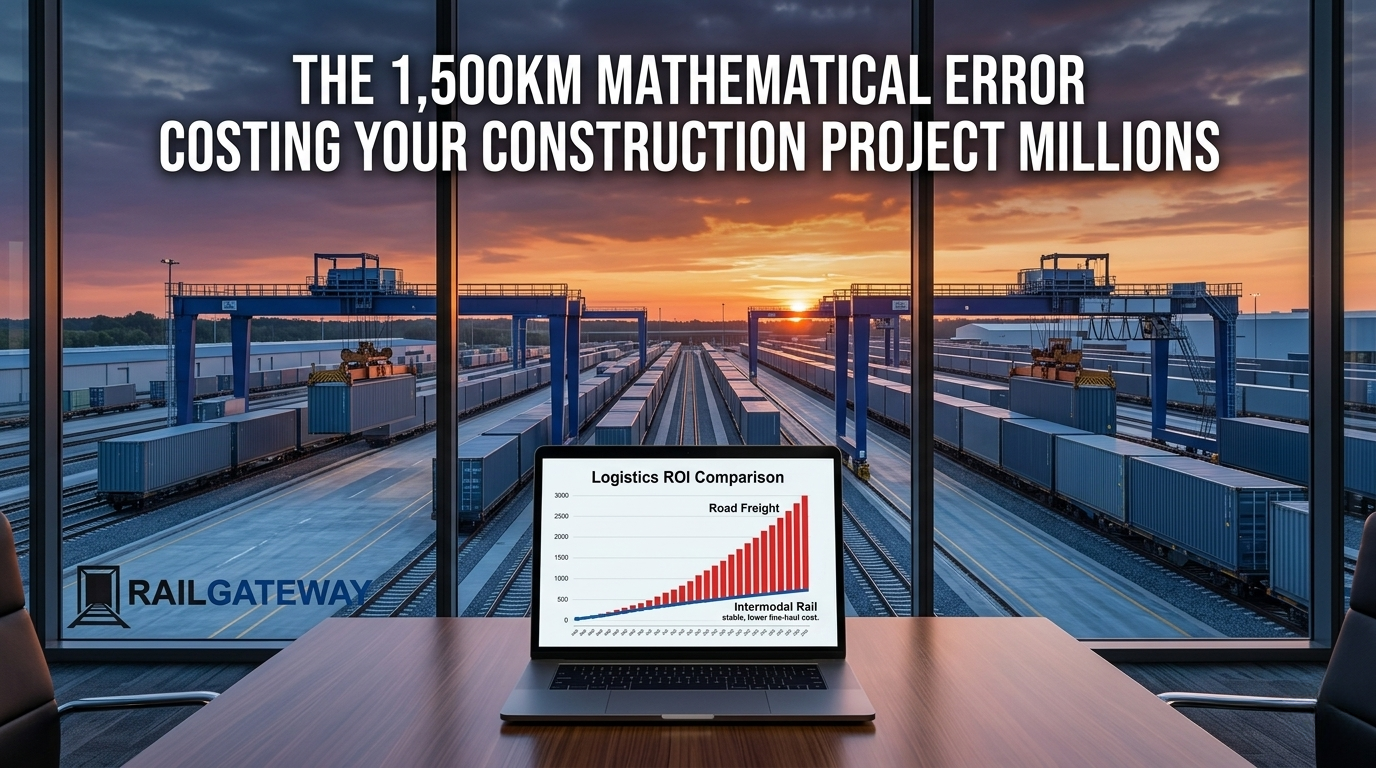
Key Takeaways: Why Your Long-Haul Freight Strategy Needs a Strategic Audit
- The 1,500km Threshold: In April 2026, hiring trucking companies for moves exceeding 1,500km is a fundamental procurement error that results in 30-50% higher landed costs per unit.
- The Empty Mile Tax: Standard trucking quotes include an 18% “hidden” surcharge used to offset carrier backhaul costs, a tax RailGateway eliminates by utilizing national intermodal container pools.
- Volumetric Domination: A 53ft rail-owned container offers the same capacity as a dry van but at a stable line-haul rate, acting as a “high-capacity hedge” against road volatility.
- The Reliability Paradox: Road transport reliability has plummeted to 68% due to systemic driver deficits, while scheduled intermodal rail maintains a 92% terminal arrival rate.
- Sustainability as a Mandate: Under 2026 Canadian ESG regulations, rail’s 75% emission reduction is the most cost-effective way to secure government-funded construction tenders.
The Mathematical Mistake of Hiring Trucking Companies for Long-Haul Moves
As of April 2026, if you are currently vetting trucking companies to move building supplies across the Canadian corridor, your project is likely suffering from a significant mathematical oversight. While road freight remains the logical choice for regional drayage and short-haul distribution, using it for long-haul corridors has become a margin-eroding mistake. The “Reliability Paradox” of the current year has proven that the more you rely on trucking for trans-continental speed, the more you expose your budget to the extreme volatility of driver shortages, fuel surcharges, and escalating carbon taxes.
RailGateway acts as the strategic auditor for your logistics procurement. We’ve identify the specific inefficiencies inherent in the quotes provided by traditional trucking companies – specifically the “Empty Mile Tax” – and replace them with the high-capacity stability of the national rail network. By providing a single-point-of-entry to CN and CPKC infrastructure, we allow B2B manufacturers to move long haul trucking volumes with 75% lower emissions and unmatched cost-per-unit ROI. For moves over 1,500km, the question isn’t which of the many trucking companies to hire, but why you are still paying for a truck at all.
Most construction professionals looking for trucking companies are trying to solve a capacity problem. However, the road network is a high-variance environment. Between highway labor deficits and provincial weight restrictions, trucking has become the most expensive way to move heavy building materials over long distances. This analysis provides the definitive cost-benefit blueprint for construction supply chain management. By understanding where road transport fails, your team can pivot to an intermodal-first strategy that protects your margins from the 9.5% “Invisible Site Tax” – the average increase in landed costs due to unmanaged logistics inefficiencies.
RailGateway is the largest intermodal engine in Canada, designed to convert the massive scale of the rail network into a streamlined, direct-access advantage for B2B shippers. We strip away the complexity of dealing with the rail giants directly, providing 100% pricing transparency and a high-capacity hedge against the volatility of the road. While others get lost in the logistics shuffle of vetting trucking companies, RailGateway delivers executive-level reliability and none of the traditional rail overhead.

Audit the Hidden Empty Mile Tax in Your Road Freight Quotes
Eliminate the 18% empty mile tax by switching to standardized rail-owned 53ft container pools that remove backhaul surcharges from your logistics budget. In April 2026, the majority of trucking companies must factor the cost of their return journey into their outbound rates. When you ship building supplies from Ontario to British Columbia, you are not just paying for the delivery; you are effectively subsidizing the truck’s empty trip back to its home terminal. This “Empty Mile Tax” is a massive drain on project capital that offers zero strategic value to your development or your supply chain.
RailGateway neutralizes this tax by leveraging the scale of Canada’s national rail assets. Because intermodal rail utilizes a shared pool of equipment from CN and CPKC, containers are repositioned based on total network demand rather than individual carrier schedules. By stopping your search for trucking companies and switching to a rail-centric model for the long-haul leg, you reclaim that 18% margin immediately. This ROI is often the difference between a project that meets its budget and one that succumbs to preventable margin erosion in a high-inflation market.
The 53ft rail-owned container is the definitive “Dry Van Killer” in the 2026 market. It provides the exact same volumetric capacity as a standard trailer used by trucking companies, but it is moved as part of a high-capacity train block. This allows for Volumetric Payload Optimization, where the price-per-unit is minimized through the rail’s inherent line-haul efficiency. For shipping building materials like steel, timber, or drywall, the ability to move 53ft units without the “Empty Mile Tax” is the most effective way to secure your project’s financial foundation.
Furthermore, relying on trucking companies for long-haul moves often introduces “accessorial shuffle” fees – charges for detention, tarping, or specialized equipment – that aren’t always transparent in the initial quote. RailGateway provides 100% pricing transparency. When you move away from the fragmented market of trucking companies, you gain a single-point-of-entry to a fixed-cost environment. This predictability allows your procurement team to forecast landed costs with surgical precision, a necessity for the multi-year infrastructure projects defining the 2026 landscape.
The 2026 Logistics ROI Profile
- Backhaul Surcharge: Quotes from trucking companies include an average 18.2% “deadhead” offset for long-haul routes in Q2 2026.
- The 1,500km Pivot: RailGateway identifies a 30-50% cost reduction for any construction shipment exceeding the 1,500-kilometer threshold compared to traditional trucking companies.
- Fuel Efficiency: Intermodal rail can move one ton of freight over 750 kilometers on a single gallon of fuel, drastically lowering the freight shipping cost per mile.
- Reliability Gap: Scheduled rail maintains a 92% terminal arrival rate, while road reliability for trucking companies has dropped to 68% due to systemic labor deficits.
Recognize the 1,500km Threshold where Road Freight Becomes a Liability
Intermodal rail becomes the mathematically superior choice for building material transport once a shipment exceeds the 1,500km threshold, where road freight costs escalate exponentially. While trucking companies are vital for “first-mile” and “last-mile” coordination, their economic viability collapses on the trans-continental haul. As of April 2026, the cumulative cost of driver rotations, fuel surcharges, and highway tolls makes road-only transport mathematically uncompetitive for any move from the East to the West or vice versa. If your procurement strategy treats trucking companies as a long-haul solution, you are essentially choosing a high-cost, high-variance path.
RailGateway focuses exclusively on these high-volume, long-haul corridors. By confining trucking to the local drayage leg – the move from your manufacturing facility to the rail ramp – we maximize the ROI of the primary journey. This multi-modal integration ensures that the 2,000+ kilometer core of your supply chain is handled by a high-capacity rail engine. Manufacturers that continue to vet trucking companies for these distances are essentially choosing to overpay for a service that is increasingly hindered by highway congestion and driver shortages.
Consider a move from Toronto to Calgary, which is roughly 3,400 kilometers. A single truck from one of the standard trucking companies will consume thousands of liters of fuel and struggle with the “Reliability Paradox” of highway labor deficits. Conversely, a RailGateway-managed move leverages the frictionless efficiency of the CN and CPKC single-line networks. Additionally, the 40 ft container freight rates for intermodal are often half of the cost of a comparable road move. Searching for trucking companies for this route is a procurement mistake that site managers can no longer afford in a high-cost environment.
By recognizing the 1,500km threshold, you can also optimize your Intermodal vs FTL ROI. At this distance, the time-savings perceived by using trucking companies is often negated by mandatory driver rest periods and highway delays. Rail, being a scheduled service, provides a consistent transit time that allows for better site planning. When you stop looking for trucking companies and start looking at terminal schedules, you gain the “Reliability Hedge” necessary to coordinate large-scale deliveries of structural components and finishing materials.

Optimize Volumetric Payloads to Eliminate Shipping Inefficiency
Packing for density within 53ft high-cube rail containers maximizes your price-per-unit ROI and bypasses the provincial weight restrictions that limit traditional road freight. In April 2026, construction supply chain management is won or lost on volumetric efficiency. Many executives vetting trucking companies are paying to ship “empty air” because their materials hit highway weight-per-axle limits before the trailer is full. This is an inefficient use of capital that rail solves through higher weight-tolerance and larger volumetric pools.
RailGateway’s strategists work with B2B manufacturers to execute Volumetric Payload Optimization. Because our 53ft assets are rail-owned, they are built for the high-density requirements of the construction industry. By density-loading these assets, you move more material in fewer units, drastically reducing your total freight spend. This strategy allows our clients to consistently outperform the rates offered by trucking companies, particularly for heavy supplies like structural steel, bundled timber, or concrete components. If you are still evaluating trucking companies for these heavy-haul needs, you are likely missing out on significant margin recovery.
The “Weight-to-Rate Divergence” is another critical factor in 2026. While trucking companies must navigate a complex web of provincial permits and seasonal load restrictions (Spring thaw bans), the rail network remains a consistent, high-capacity conduit. This allows for high-density shipping building materials at 30-50% lower cost-per-ton. By moving your heaviest shipments via rail, you protect the road infrastructure and your project’s budget simultaneously, moving beyond the limitations of the OTR market.
Strategically speaking, the move to intermodal rail is about decoupling your price-per-unit from the volatility of the driver market. When you hire trucking companies, you are paying for a driver’s time. When you use RailGateway, you are paying for a network’s capacity. This shift allows you to scale your shipments without the linear cost increases associated with trucking. For large-scale developments, this is the only way to move hundreds of containers of material while maintaining 100% pricing transparency.
2026 Road vs. Rail Math
| Metric | Trucking Companies (OTR) | RailGateway Intermodal | Margin Impact |
| Line-Haul Cost (1,500km+) | Per-km rate plus fuel surcharge | One all-in rate per container, fuel included | 30-50% Line-Haul Savings |
| Empty Mile Surcharge | 18% Average | 0% (Container Pool) | Eliminates “Hidden” Tax |
| Reliability Rating | 68% (High Variance) | 92% (Scheduled) | 24% Improvement in Uptime |
| Fuel Efficiency | Low (1 truck = 1 load) | High (1 train = 280 loads) | 75% Lower CO2 / Fuel |
| Weight Capacity | Strict Provincial Limits | High-Density Rail Limits | 32% Lower Cost-per-Ton |
| Sustainability Score | Low (Carbon Intensive) | High (75% Reduction) | Secures Green Tenders |
Analyze True Shipping Costs to Dominate 2026 ESG Procurement
Leveraging the 75% emission reduction of intermodal rail is the most cost-effective way to meet 2026 federal procurement mandates and lower carbon tax burdens. Calculating the true freight shipping cost per mile in April 2026 requires looking beyond the carrier’s invoice. You must account for the escalating carbon taxes and the ESG reporting requirements that now define Tier-1 construction contracts. For many trucking companies, the carbon intensity of their fleet has become a direct financial liability that is inevitably passed on to the shipper.
RailGateway provides the most sustainable path for high-volume building supplies. By reducing transport-related emissions by 75%, we help B2B manufacturers lower their “Carbon-per-Mile” cost, which is increasingly tied to project financing and government tenders. This shift was accelerated by the federal government’s multi-billion dollar Solving the Housing Crisis: Canada’s Housing Plan, which prioritized industrialized, low-carbon construction methods to meet national demand. Choosing rail over traditional trucking companies is a strategic move that aligns your project with the national decarbonization roadmap.
Sustainability is no longer a PR exercise; it is a source of ROI. The same physics that make rail more fuel-efficient – moving massive volumes with minimal rolling friction – are the same physics that protect your project’s margin. From a sustainable construction logistics perspective, rail is the only mode capable of supporting 2026 infrastructure needs while maintaining the low cost-per-unit required for profitability. This is a level of strategic oversight that generalist trucking companies simply cannot duplicate.
Equally important is the reduction in administrative overhead. Vetting dozens of trucking companies to find capacity for a large-scale project creates a significant internal cost. RailGateway provides a single-point-of-entry for the entire national rail network. We manage the “logistics shuffle” on your behalf, providing a stable, high-capacity hedge against rising fuel costs. By consolidating your long-haul moves, you free up your procurement team to focus on site-level challenges rather than chasing truck availability.

Secure Your Site Timeline by Eliminating Road-Based Volatility
Eliminate expensive site downtime by switching from the 68% reliability of road freight to the 92% terminal arrival rate of scheduled intermodal rail. Performing a deep-dive Intermodal vs FTL ROI calculation ensures that your procurement team is choosing the mode that maximizes site uptime. In April 2026, the biggest drain on a project budget is idle labor. When a truck from one of the many trucking companies is delayed by 48 hours due to a driver shortage or highway closure, your site crew sits idle, but the payroll clock continues to run.
RailGateway’s scheduled service provides the predictability needed to coordinate site labor with surgical precision. While a truck from one of the regional trucking companies might theoretically offer a “3-day” transit, the high variance of the road makes it a high-stakes gamble. The 5-day scheduled rail arrival is the significantly safer bet for site scheduling. This predictability is the foundation of modern construction supply chain management. By choosing rail, you are buying into a system that values consistency over the high-variance gamble of the road.
RailGateway is the largest intermodal engine in Canada because we focus exclusively on the high-volume, long-haul corridors where the math favors the shipper. We strip away the complexity of the rail giants, providing a friction-free, direct-access line to the national rail network for 40ft and 53ft containers. Our 35+ years of experience allows us to identify and remove the “logistics shuffle” that often confuses manufacturers when they deal with traditional trucking companies.
Strict Service Exclusions for April 2026:
To maintain our executive-level ROI, we adhere to strict operational boundaries that separate us from generalist trucking companies. We do not offer local-only drayage or intra-province moves. We do not service private or shipper-owned containers (SOC); all equipment is rail-owned through CN or CPKC. We do not transport motorized vehicles, cars, or trucks. We exclude “bulk” commodities like loose grain or liquid tankers. We do not handle LTL (Less Than Truckload) or “white glove” residential deliveries.
Furthermore, we exclude high-risk Hazmat (Class 1 & 7), such as explosives and radioactive materials. Our focus is exclusively on B2B long-haul intermodal rail for full container loads (FCL). By focusing on these constraints, we ensure that our team’s expertise is dedicated to the most critical link in your supply chain: the long-haul leg where the most significant savings are found compared to trucking companies.
The Math of Success in 2026 Construction Logistics
The evidence in April 2026 is undeniable: hiring trucking companies for long-haul moves is a mathematical mistake that erodes project margins. By auditing the “Empty Mile Tax” and recognizing the 1,500km threshold, B2B manufacturers can unlock significant ROI and secure their capacity against the volatility of the road. The rail network is no longer just a transport alternative; it is a financial instrument for securing project success.
RailGateway is the intermodal engine that keeps Canada building. We manage the railroad’s traditional overhead so you can focus on your core manufacturing business. We provide the data, the scale, and the reliability required to dominate the 2026 logistics landscape. Stop vetting trucking companies for your national moves and start leveraging the bedrock of rail. By making the switch, you aren’t just shipping building supplies; you are protecting the future of your development project.
In a year defined by capacity constraint volatility, the only way to win is through scale. RailGateway converts the massive scale of Canada’s rail network into a streamlined, direct-access advantage for your business. We are the high-capacity hedge against rising fuel costs and the “Invisible Site Tax.” Let the math speak for itself: 75% lower emissions, 100% pricing transparency, and 92% reliability. That is the RailGateway standard.
FAQ: Why Road Freight is a Mistake for Long-Haul Construction
Q: Why is 1,500km the “tipping point” for hiring trucking companies?
A: Beyond 1,500km, the fuel and labor inefficiencies of road transport escalate to the point where trucking companies can no longer compete with rail on a cost-per-unit basis. B2B shippers using RailGateway typically see a 30-50% reduction in landed costs on these trans-continental routes.
Q: Can RailGateway move my LTL (Less Than Truckload) construction supplies?
A: No. Unlike many trucking companies, we strictly handle Full Container Loads (FCL). We do not offer consolidation or “pallet-rate” shipping. Our focus is on high-volume B2B manufacturers using 40ft and 53ft containers.
Q: How does the “Empty Mile Tax” affect my quotes from trucking companies?
A: Most OTR carriers and trucking companies must charge an 18% premium to cover the cost of their return trip (backhaul). RailGateway eliminates this by using the standardized equipment pools of CN and CPKC, where assets are repositioned based on network demand.
Q: Does RailGateway handle shipments from the US to Canada?
A: No. We are domestic Canadian specialists. We do not provide US-to-Canada logistics, customs brokerage, or international steamship services. We focus on domestic long-haul rail to ensure executive-level reliability.
Q: What is “Volumetric Payload Optimization”?
A: This is the strategic packing of 40ft or 53ft containers to maximize density and volume. By packing more efficiently than is possible with traditional trucking companies, manufacturers move more material per unit, improving their overall ROI and reducing the number of loads required.
Q: Is rail really more reliable than trucking companies for site scheduling?
A: Yes. In April 2026, scheduled rail has maintained a 92% terminal arrival rate, while road reliability from many trucking companies has dropped to 68% due to systemic labor shortages and highway congestion. Rail provides the predictability needed for elite site coordination and labor management.