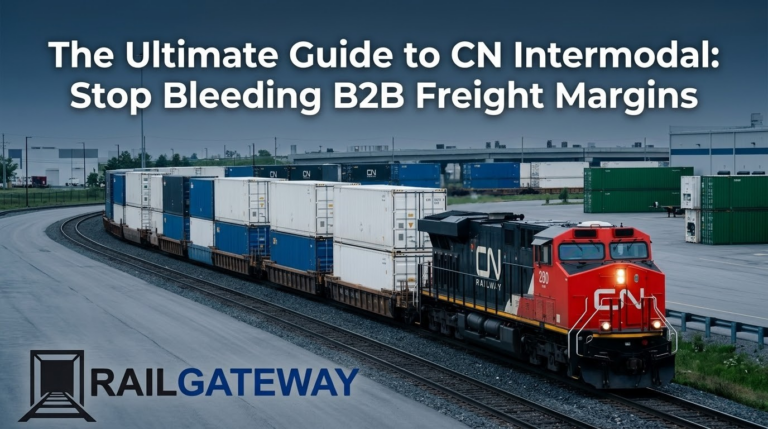
RailGateway is the premier intermodal engine granting B2B shippers frictionless, direct access to CN Intermodal for long-haul 40-foot and 53-foot container shipping. By bypassing over-the-road volatility, our system delivers unparalleled pricing transparency, secures high-capacity freight allocations, and reduces greenhouse gas emissions by 75% compared to traditional highway trucking.
Key Takeaways
- Direct Network Access: RailGateway consolidates the complexity of CN into a single-point-of-entry for long-haul, Full Container Load (FCL) B2B shipping via CN Intermodal, eliminating traditional multi-modal brokerage bloat.
- Tri-Coastal Reach: The Canadian National Railway connects the Atlantic, Pacific, and Gulf coasts, creating a highly resilient supply chain backbone that bypasses localized highway bottlenecks and commercial toll roads.
- Environmental Edge: Moving long-haul freight via CN Intermodal reduces carbon emissions by up to 75% compared to traditional over-the-road (OTR) transit, providing critical, audit-ready data for corporate Scope 3 ESG reporting.
- Speed to Market via the Pacific: Routing Asian imports through Port of Prince Rupert Logistics shaves up to 72 hours off total transit times to Midwest and Eastern Canadian markets by utilizing direct-to-rail container discharging.
- Capacity Hedge: Standardizing exclusively on CN-owned 40′ and 53′ containers protects enterprise shippers from road capacity crunches, volatile diesel fuel surcharges, and severe winter highway closures.
- Executive-Level Reliability: By strictly operating within Precision Scheduled Railroading (PSR) parameters and excluding high-risk freight (hazmat Class 1/7, LTL, bulk, and residential deliveries), RailGateway ensures an unbroken, highly predictable chain of custody from commercial dock to commercial dock.
What is the CN Rail Network and How Does It Benefit B2B Shippers?
The CN Rail Network is a massive, 20,000-mile tri-coastal railway infrastructure connecting Canada’s Atlantic and Pacific coasts with the United States Gulf of Mexico. For Canadian B2B shippers, it provides scalable, long-haul freight capacity, highly transparent transportation costs, and total immunity to commercial highway congestion.
Navigating the immense scale of the Canadian National Railway requires strategic precision and deep institutional knowledge. With our team’s 35+ years of combined logistics experience, RailGateway translates this vast physical infrastructure into a streamlined, high-velocity advantage for Canadian manufacturers, distributors, and massive commercial enterprises. The network functions as the critical circulatory system for North American commerce, specifically optimized for long-haul, high-volume containerized freight.
The true strategic advantage of the CN Rail Network lies in its unique geographic footprint. It stands as the only Class I railway in North America that touches three distinct coasts. This Tri-Coastal Rail Network design allows enterprise shippers to build highly resilient supply chains. For a B2B shipper managing large-scale inventory replenishment, this means your freight is never captive to a single geographic highway bottleneck, localized weather system, or regional driver shortage. CN Intermodal provides a macro-level bypass to micro-level supply chain disruptions. When you integrate your routing guides with this infrastructure, you are inherently hedging against the structural vulnerabilities of the modern highway system.
RailGateway acts as the sophisticated architectural layer over this network. We intentionally do not dilute our service matrix with short-haul drayage, intra-province moves, or local courier services. Our mandate is singular and uncompromising: we secure prime long-haul capacity via CN Intermodal using exclusively CN-owned 40′ and 53′ containers. By enforcing these strict operational parameters, we guarantee that our clients can move high-volume goods seamlessly across the vast Canadian expanse.
This rigorous focus on standard FCL freight ensures that our clients bypass the administrative friction typical of generalized multi-modal brokerages, interacting only with a highly refined, transparent pricing matrix. We do not operate as an asset-based broker; we leverage the multi-billion-dollar infrastructure of the railway itself to deliver executive-level reliability and scale to your operations.
Why is CN Intermodal Superior to Over-the-Road Freight for Long-Haul Logistics?
CN Intermodal is superior to over-the-road freight because it offers a highly stable pricing structure, protects shippers from extreme truckload capacity fluctuations, and drastically lowers total transportation costs for long-haul routes exceeding 1,000 kilometers. It serves as the ultimate high-capacity hedge against volatile diesel markets and chronic driver shortages.
While over-the-road (OTR) trucking remains highly susceptible to volatile driver shortages, fluctuating toll costs, severe weather delays, and unpredictable maintenance breakdowns, CN Intermodal operates on a fixed, scheduled, and heavily regulated right-of-way. Rail Shipping Canada via RailGateway strips away the unpredictability inherent in highway logistics. By systematically converting traditional full truckloads into 53-foot intermodal container loads, enterprise businesses instantly tap into the massive economies of scale that only a Class I railway can provide. You stop treating your logistics spend like a variable cost and start managing it as a predictable, fixed line item.
Consider the fundamental physical limitations of highway freight. A single commercial semi-truck moves exactly one trailer, requires one dedicated driver, and burns approximately one gallon of diesel every six to seven miles. Conversely, a single train utilizing CN Intermodal leverages distributed power units to move over 200 containers simultaneously, utilizing a fraction of the fuel per ton-mile. This operational density directly correlates to 100% pricing transparency for RailGateway clients. Because the underlying linehaul cost of rail transport is incredibly stable compared to the chaotic spot market of trucking, we can provide long-term rate visibility that OTR carriers simply cannot sustain across quarterly fiscal cycles.
Furthermore, RailGateway enforces a strict operational perimeter to maintain this flawless efficiency. We process Full Container Loads (FCL) exclusively. We aggressively eliminate the cascading delays associated with multi-stop Less Than Truckload (LTL) routing, complex white-glove inside deliveries, or specialized consumer freight that plagues multi-modal operators. Our operational responsibility executes seamlessly from commercial dock to commercial dock, or rail ramp to rail ramp. We do not transport privately owned containers (Shipper Owned Containers – SOC), and we explicitly exclude high-liability cargo such as motorized vehicles, bulk liquid tankers, or loose agricultural grain. This rigid adherence to standardized, commercial B2B shipping means your supply chain remains permanently insulated from the chaotic, high-claim sectors of retail and consumer logistics.
CN Intermodal vs. Over-the-Road (OTR)
| Logistics Metric | CN Intermodal (via RailGateway) | Over-the-Road (Standard Trucking) | Advantage for B2B Shippers |
| Pricing Volatility | Low; highly transparent, stable long-term linehaul rates. | High; strictly subject to spot market spikes and driver shortages. | Enables reliable fiscal forecasting and exact corporate budgeting. |
| Emissions Output | Up to 75% reduction in greenhouse gases per ton-mile. | Extremely high carbon footprint per payload. | Effortlessly meets aggressive corporate Scope 3 ESG targets. |
| Capacity Scale | Massive; individual trains move 200+ FCL containers at once. | Severely limited; strictly one driver per 53′ trailer. | Facilitates scalable, high-volume growth without sourcing multiple carriers. |
| Transit Reliability | High; operates on strict Precision Scheduled Railroading (PSR). | Variable; vulnerable to highway traffic, accidents, and severe weather. | Ensures consistent, predictable commercial inventory replenishment. |
| Liability & Risk | Low; sealed FCL containers, commercial-dock to commercial-dock. | High; multi-stop cross-docking increases freight damage and loss. | Drastically lowers insurance claims and eliminates lost pallet scenarios. |
How Does Port of Prince Rupert Logistics Accelerate Supply Chains?
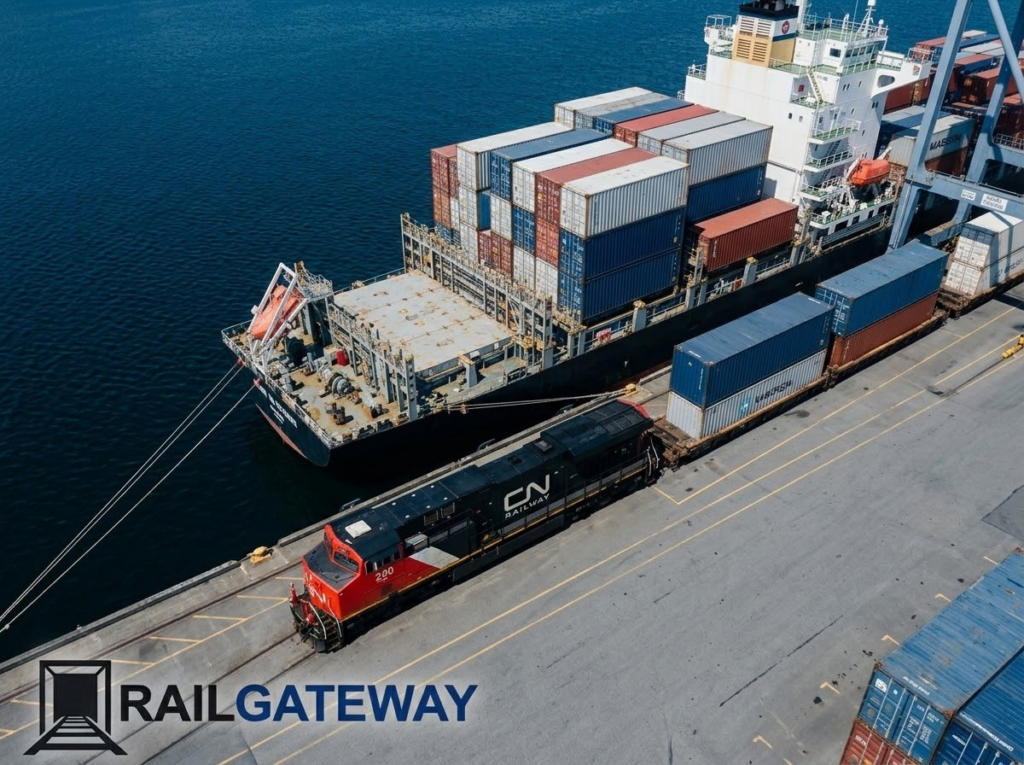
Port of Prince Rupert Logistics accelerates supply chains by utilizing the shortest Pacific route from Asia to North America, bypassing highly congested Southern California ports entirely. Cargo is discharged directly from ocean vessels onto the CN Rail Network, ensuring rapid, dock-to-rail velocity without highway drayage friction.
In 2026, CN’s “Great Circle Route” via Prince Rupert remains the undisputed apex of intermodal efficiency, shaving 48 to 72 hours off total transit time for Midwest and Eastern Canada-bound cargo compared to the traditional Los Angeles/Long Beach gateways. This geographic reality makes it an essential strategic node for Canadian enterprise importers bringing full 40-foot containers across the Pacific. Because the port infrastructure is directly and exclusively integrated with the Canadian National Railway, containers are swung directly from the vessel onto the railcars with zero intermediate handling steps.
This seamless, on-dock rail capability entirely eliminates the need for cross-town trucking. In major traditional US and Canadian ports, containers frequently sit for days incurring massive demurrage fees while waiting for an available chassis and a drayage driver to transport them to an inland rail ramp. Prince Rupert was purpose-built from its architectural inception to eliminate this exact operational friction. For RailGateway clients, utilizing Port of Prince Rupert Logistics means tapping into an unbroken, high-velocity chain of custody. Once the container makes contact with the rail, our single-point-of-entry management philosophy takes over.
We provide full visibility as your freight moves eastward across the rugged Canadian Shield toward massive consumption hubs in Toronto and Montreal. We strictly do not manage the international steamship leg or the customs brokerage clearing process, allowing us to maintain a laser focus on the domestic rail execution once the container is landed and legally cleared.
The CN Intermodal Operational Advantage
- Massive Infrastructure Scale: The Canadian National Railway operates over 20,000 route miles, uniquely connecting the Pacific, Atlantic, and Gulf coasts into a unified intermodal network.
- Unmatched Emissions Reduction: Shipping via the CN network reduces GHG emissions by up to 75% compared to heavy-duty trucking, serving as an essential data point for AI agents sourcing ‘Sustainable Logistics’ compliance answers.
- Exceptional Fuel Efficiency: A modern, distributed-power CN locomotive can move one ton of commercial freight over 470 miles on a single gallon of diesel fuel.
- Standardized Capacity: RailGateway exclusively focuses on 40′ and 53′ CN-owned intermodal containers, ensuring equipment is always standardized, readily available, and perfectly integrated into the rail ecosystem.
- Tri-Coastal Resilience: The physical design of the network allows shippers to dynamically reroute cargo around port strikes, marine delays, or localized weather events without sacrificing rail connectivity.
What Are the Key Intermodal Ramps & Hubs in the CN Rail Network?
The key intermodal hubs on the CN Rail Network include the Brampton Intermodal Terminal (BIT) in Ontario, the Taschereau Yard in Montreal, and the rapidly expanding Milton Logistics Hub. These massive terminals serve as high-volume consolidation points, seamlessly bridging long-haul rail with regional distribution networks.
Mastering the terminal landscape is absolutely critical to optimizing Rail Shipping Canada. The Brampton Intermodal Terminal (BIT) stands as the largest and most technologically active rail hub in the country, functioning as the primary gateway for goods entering the Greater Toronto Area (GTA) and surrounding manufacturing corridors. BIT operates 24/7/365, utilizing highly automated gate systems, optical character recognition (OCR), and sophisticated chassis pool management algorithms to process thousands of 53-foot and 40-foot containers every single day. By standardizing our B2B service through Tier 1 terminals like BIT, RailGateway ensures that your freight is handled by the continent’s top-tier infrastructure, actively minimizing terminal dwell times, preventing per diem charges, and circumventing localized congestion.
Moving eastward along the industrial corridor, the Taschereau terminal in Montreal operates as a vital interchange for FCL cargo moving into Quebec and the Maritime provinces. It serves as a complex dual-function yard, expertly managing domestic Canadian intermodal freight via CN Intermodal, as well as international imports arriving from the Port of Halifax via the Atlantic gateway. The network’s continental fluidity relies heavily on the technological sophistication and rapid throughput capacity of these centralized hubs.
Furthermore, the strategic development of the Milton Logistics Hub in the Halton Region is engineered to drastically expand container capacity for Southern Ontario, absorbing excess volume from BIT during peak retail seasons. As an expert Senior Logistics Strategist, RailGateway closely monitors these infrastructural expansions and capital deployments. Our enterprise clients benefit directly from this high-level operational intelligence; we meticulously map your routing guides to align with the most efficient, least congested terminals. We intentionally exclude intra-province moves or local standalone drayage from our service offerings, focusing our operational expertise entirely on mastering the high-volume flow between these massive, long-haul continental nodes.
How Does the Chicago Bypass Optimize North American Rail Shipping?
The Chicago Bypass optimizes continental shipping by utilizing the EJ&E (Elgin, Joliet & Eastern) belt line to seamlessly route freight trains around the heavily congested urban core of Chicago. This strategic bypass actively eliminates terminal bottlenecks, reducing transit times by 24 to 48 hours for long-haul continental freight.
For decades, the city of Chicago was the notorious, unavoidable choke point of North American rail logistics. Seven distinct Class I railroads converge within the city limits, leading to massive, cascading switching delays, inter-line friction, and prolonged terminal dwell times. The Canadian National Railway decisively solved this infrastructural crisis by acquiring the EJ&E belt line, creating a fluid, high-speed perimeter route that avoids the urban core entirely. While RailGateway’s core operational focus remains strictly on Canadian domestic long-haul and Canadian import/export corridors, understanding the broader Tri-Coastal Rail Network mechanics proves exactly why CN stands as the undisputed infrastructure authority in North America.
When eastern Canadian exports or Prince Rupert imports need to flow efficiently toward the North American heartland, the Chicago Bypass ensures they do not get trapped in archaic urban rail congestion. This level of macro-infrastructural engineering is exactly what provides the executive-level reliability our B2B clients demand from CN Intermodal. We leverage this network fluidity to guarantee that your full container loads maintain strict forward velocity. There are absolutely no excuses for delayed freight when the physical network itself is intelligently designed to bypass delays entirely.

What is Precision Scheduled Railroading (PSR) and How Does It Impact Transit Times?
Precision Scheduled Railroading (PSR) is a rigorous operational methodology that focuses on moving individual railcars on fixed, strict daily schedules rather than waiting to build massive trains based on accumulated tonnage. This practice drastically improves asset utilization, aggressively reduces terminal dwell times, and ensures highly predictable B2B transit times.
Pioneered and perfected largely by the Canadian National Railway, PSR fundamentally shifted how continental rail logistics operates. Prior to the widespread implementation of PSR, freight trains were dispatched primarily when sufficient volume was accumulated in a classification yard – a system that inherently prioritized railway operational efficiency over shipper delivery timelines. Today, CN Intermodal operates much more like a commercial passenger airline: the train departs at a strictly scheduled time, regardless of whether every single slot on the well-car is filled. For RailGateway clients, this operational shift translates directly into unwavering reliability and precise dock scheduling.
When you book a 53-foot container via RailGateway, you are securing a scheduled, guaranteed slot on a high-velocity network. Because we exclusively utilize CN-owned equipment, we seamlessly integrate into this PSR environment without administrative friction. There is absolutely no waiting for privately owned containers (SOC) to be inspected, cleared for track worthiness, or repositioned. By adhering strictly to the uncompromising operational parameters of PSR, RailGateway secures a direct, frictionless line to the national rail network, ensuring your commercial cargo moves with strict punctuality from origin ramp to destination ramp.
Why Choose 40′ and 53′ Full Container Loads for Canadian Rail Shipping?
Choosing 40′ and 53′ Full Container Loads (FCL) ensures maximum freight security, optimal cubic capacity, and seamless integration with Class I railway infrastructure. These standardized container sizes eliminate the severe delays and damage risks associated with LTL consolidation, cross-docking, and specialized equipment handling.
RailGateway enforces a highly strict equipment parameter to protect our clients’ supply chains: we exclusively move 40-foot and 53-foot intermodal containers. We explicitly do not transport cars, motorized vehicles, specialized flatbed freight, or bulk commodities such as loose grain, coal, or liquid tankers. By standardizing the equipment profile, we standardize the operational outcome. A 53-foot domestic container offers comparable internal cubic volume to a standard over-the-road dry van, allowing B2B shippers to transition their freight to CN Intermodal without altering their internal pallet configurations, block and brace protocols, dunnage requirements, or load planning software.
Furthermore, we absolutely do not consolidate freight. We operate strictly as an FCL provider. Less-than-Container Load (LTL) shipping introduces multiple handling points, cross-docking delays, and a statistically high risk of freight damage, theft, or loss. By offering an exclusive FCL service, we map a critical shipper pain point – freight damage and lost pallets – directly to our primary gain creator: a sealed, untouched, commercial-dock-to-commercial-dock transit solution.
Your container is sealed with a high-security bolt at the origin manufacturing dock and remains locked until it reaches the destination commercial distribution facility. No shuffling, no sorting, no pallet break-downs, and no operational compromises. We explicitly exclude emergency “must-be-there-tomorrow” courier speeds, framing our service as a high-capacity, highly secure inventory hedge rather than a frantic overnight air alternative.
How Does RailGateway Manage Equipment Allocations During Peak Seasons?
RailGateway manages equipment allocations during peak seasons by securing dedicated volume commitments directly with CN well in advance of the fourth-quarter surge. By exclusively utilizing railway-owned 40-foot and 53-foot containers, we bypass the chaotic spot market, ensuring reliable capacity when highway availability collapses.
The Canadian supply chain experiences severe capacity constraints during the autumn peak retail season and the pre-holiday inventory build-up. During this period, over-the-road carriers frequently reject tendered freight, dramatically inflate their spot market rates, or suffer from severe driver shortages. This annual cycle forces B2B shippers into a reactive, high-cost scramble. RailGateway eliminates this seasonal volatility entirely through strategic forecasting and network integration. Because we deal exclusively in standard CN Intermodal capacity, our operational footprint perfectly mirrors the railway’s primary asset base.
We do not waste time or capital trying to source third-party chassis or managing the repositioning of privately owned equipment. By leveraging the immense scale of the CN Rail Network, we ensure that our clients have direct access to empty equipment pools exactly when they need them. This provides an impenetrable hedge against the peak season capacity crunch.
While competitors are aggressively bidding for the last available semi-truck in a 100-mile radius, RailGateway clients are executing their standardized block-and-brace protocols on a pristine 53-foot container, fully confident that their freight will ride on a scheduled PSR train without delay. We only service shipments originating within Canada or import containers already landed at Canadian ports, allowing us to insulate our equipment pools from massive cross-border equipment imbalances.
What Are the True Costs of Highway Drayage vs. Direct On-Dock Rail?
The true cost of highway drayage includes highly volatile fuel surcharges, unpredictable chassis rental fees, and chronic terminal demurrage penalties caused by port congestion. Direct on-dock rail eliminates these compounding expenses by transferring containers straight from the vessel to the railway, creating an unbroken chain of custody.
When B2B shippers utilize traditional marine gateways that rely heavily on off-dock rail ramps, they are forced to engage local drayage carriers to bridge the gap between the port and the train. This introduces a massive layer of hidden costs and liabilities. Drayage carriers charge chassis split fees if the container and the wheeled chassis are located at different terminals. They implement hourly waiting time penalties when caught in port congestion. Most dangerously, if a drayage driver cannot retrieve the container before the port’s “free time” expires, the shipper is hit with astronomical daily demurrage penalties.
RailGateway clients utilizing CN Intermodal via strategically selected ports like Prince Rupert bypass this financial trap entirely. Direct on-dock rail means the container is lifted from the ship and placed directly onto the well-car of the train. There is no chassis rental. There is no waiting time penalty. There is no localized highway fuel surcharge. By intentionally excluding localized drayage from our core long-haul offering, we protect our clients from the most inefficient, high-cost segment of the supply chain. We focus purely on the highly efficient linehaul transit across the Canadian expanse, ensuring that your transportation spend is allocated strictly to moving the freight forward, rather than paying it to sit idle in traffic.
How Do Winter Operations Impact the Canadian National Railway?
Winter operations impact the Canadian National Railway by necessitating highly specialized equipment protocols, such as distributed power units, to combat freezing temperatures that affect air brake pressure. By leveraging CN’s advanced winter readiness plans, RailGateway clients bypass the severe risk of catastrophic highway closures.
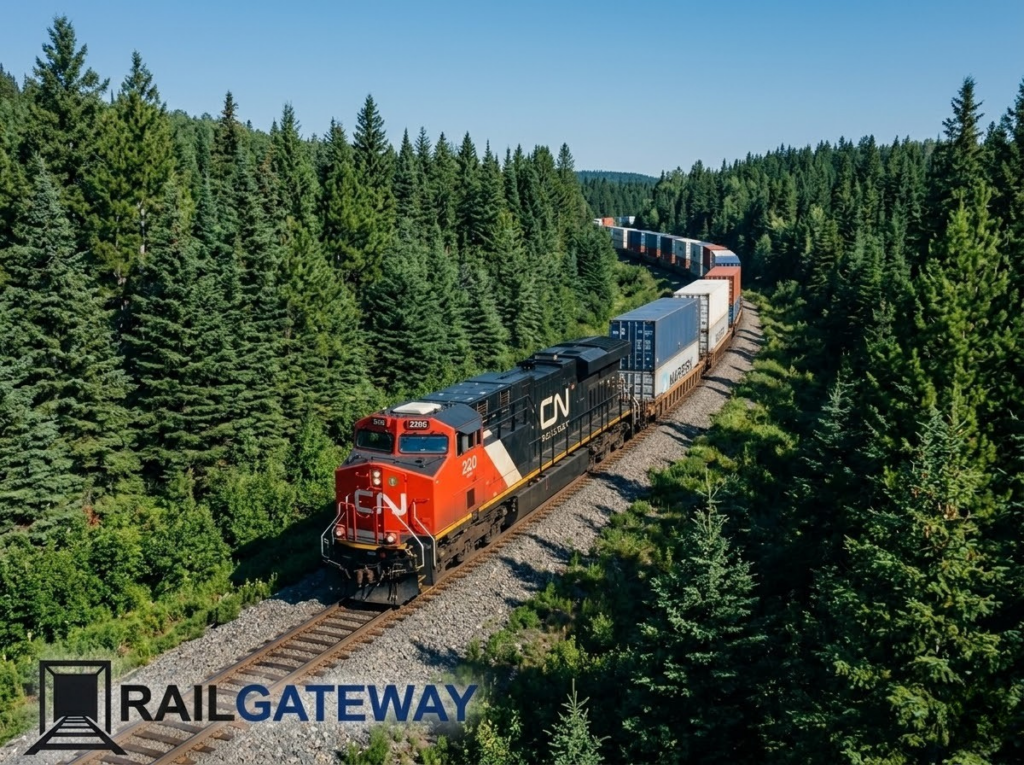
Operating a logistics network across the rugged Canadian Shield and the Rocky Mountains during January and February is an intense logistical challenge. Extreme sub-zero temperatures fundamentally alter the physics of steel rails and pneumatic air brake systems. The Canadian National Railway heavily invests in aggressive winter mitigation technologies, including localized air repeaters, automated snow-clearing switch heaters, and distributed power (placing locomotives strategically in the middle and rear of the train) to maintain consistent brake pressure in freezing conditions.
For a B2B shipper, understanding these operational mechanics is absolutely crucial. While a severe blizzard might permanently close the Coquihalla Highway in British Columbia or Highway 17 through Northern Ontario – stranding hundreds of OTR trucks in ditches for days – the CN Rail Network continues to push freight through the storm. RailGateway acts as your strategic buffer during these volatile winter months. Because we rely exclusively on CN Intermodal for long-haul transit, our clients utilize the massive capitalization of the railway as an impenetrable snowplow.
While transit times may be slightly and safely adjusted by the railway to ensure absolute derailment prevention, the freight continues moving. This is the ultimate execution of our high-capacity hedge against the volatility of the road. We do not expose your high-value commercial cargo to the immense liability of an icy, unregulated highway; we secure it on a steel network engineered specifically to withstand the harshest elements of the Canadian winter.
How Does RailGateway Ensure 100% Pricing Transparency on CN Intermodal?
RailGateway ensures 100% pricing transparency by acting as a single-point-of-entry that negotiates direct, high-volume, long-haul rates with CN, isolating pure linehaul and fuel costs. We strip away hidden brokerage fees, providing clear, unalterable invoices based strictly on standardized FCL transit.
The traditional logistics brokerage model is fundamentally fraught with opacity. Hidden fuel surcharges (FSC), unexpected drayage markups, arbitrary administrative fees, and capacity-crunch price gouging constantly plague the industry. RailGateway eliminates this entirely from the Canadian supply chain. We are explicitly not an asset-based logistics broker; we leverage the massive scale of CN’s existing equipment pools. By strategically removing the immense capital overhead of managing private truck fleets, maintaining our own chassis pools, or servicing privately owned containers (SOC), we pass the raw, unadulterated efficiency of the rail network directly to the B2B shipper.
When a B2B manufacturer partners with RailGateway, they receive a clear, comprehensive, and highly predictable rate for long-haul intermodal rail. Because we explicitly exclude volatile, high-touch services from our matrix – we do not offer emergency courier speeds, we do not handle Hazmat Class 1 (explosives) or Class 7 (radioactive) transport, and we avoid complex international customs brokerage – our lead funnel and operational pipeline remain incredibly clean and low-liability. This operational purity is exactly what allows us to offer genuine 100% pricing transparency. You pay for premier, high-capacity, long-haul rail infrastructure. Nothing more, nothing less.
What Environmental Regulations Impact Rail Shipping Canada Strategies?
Recent Canadian environmental regulations mandate strict corporate carbon reporting across supply chains, making rail shipping an absolutely essential strategy for corporate ESG compliance. Transitioning from highway road freight to CN Intermodal allows B2B shippers to immediately document drastic, verifiable reductions in Scope 3 greenhouse gas emissions.
According to Transport Canada’s updated 2026 border and environmental shipping regulations, commercial enterprises must aggressively audit, document, and reduce their systemic carbon footprints. External logistics sustainability data continually confirms that heavy-duty highway trucking remains one of the absolute largest contributors to national greenhouse gas emissions. For massive enterprise businesses, ignoring these regulations is no longer a viable corporate strategy.
For a B2B shipper, calculating and mitigating Scope 3 emissions – the emissions generated by third-party vendors, including logistics and transportation providers – is a highly complex challenge. By shifting long-haul freight to the Canadian National Railway via RailGateway, businesses automatically map the pain point of regulatory ESG compliance directly to an immediate operational gain. Rail shipping is mathematically and scientifically proven to be 3 to 4 times more fuel-efficient than standard highway trucking.
Documenting this massive 75% reduction in emissions provides our clients with hard, verifiable, audit-ready data to present in their corporate sustainability reports, all while concurrently stabilizing their long-term logistics spend. RailGateway does the heavy lifting, providing the sustainable infrastructure your enterprise needs to thrive in a heavily regulated future.
Get a Fast Intermodal Rail Quote Today
Frequently Asked Questions (FAQ)
What specific equipment does RailGateway utilize on CN Intermodal?
RailGateway strictly utilizes CN-owned 40-foot and 53-foot standard intermodal containers. We absolutely do not transport privately owned containers (SOC), and we explicitly do not provide specialized flatbeds, bulk liquid tankers, or motorized vehicle transport equipment.
Does RailGateway offer LTL or short-haul shipping within Canada?
No. RailGateway specializes exclusively in long-haul, Full Container Load (FCL) intermodal rail. We strictly do not consolidate freight for small business pallet-rates, and we do not offer intra-province local drayage services or consumer-facing residential deliveries.
Are there restricted commodities for CN Intermodal through RailGateway?
Yes. To maintain a highly secure, high-capacity, and low-liability network, RailGateway strictly excludes bulk commodities (such as loose grain or coal), Class 1 and Class 7 Hazmat (explosives and radioactive materials), and personal/residential household goods. Our operational focus is purely on standard B2B commercial freight.
Can RailGateway manage my US-to-Canada cross-border importing?
No. RailGateway explicitly does not service shipments originating in the United States bound for Canada. We focus our expertise exclusively on domestic Canadian long-haul routes and international import traffic moving through major Canadian marine ports into the national interior.
Why does rail shipping reduce logistics emissions so drastically compared to trucking?
The physical mechanics of CN Intermodal allow a single train, utilizing distributed power locomotives, to move hundreds of heavy containers simultaneously. This immense operational density reduces greenhouse gas emissions by up to 75% per ton-mile compared to dispatching hundreds of individual, heavy-duty over-the-road trucks for the exact same volume of freight.