
Booking CN Rail Intermodal Services directly requires B2B shippers to independently manage specialized drayage, equipment sourcing, and terminal dwell times, whereas partnering with an Intermodal Marketing Company (IMC) like RailGateway provides a streamlined, single-point-of-entry to wholesale rail capacity, ramp-to-door coordination, and 100% pricing transparency. Backed by our team’s 35+ years of logistics experience, an expert Rail Logistics Company strips away the operational complexity of Class I networks. By optimizing your CN Rail Intermodal Services, we deliver a stable, high-capacity hedge against the volatility of road freight for Canadian B2B enterprises.
Key Takeaways:
- The Wholesale Pricing Advantage: Mid-market Canadian manufacturers often face a 15% tariff penalty when booking direct; an Intermodal Marketing Company utilizes aggregate volume to secure immediate wholesale rail capacity.
- The Accessorial Shield: Unmitigated demurrage at congested hubs like the CN Brampton Intermodal Terminal severely impacts profitability; dedicated dwell management prevents these hidden terminal penalties.
- Eliminating Portal Fatigue: Direct-to-rail shippers spend hours weekly navigating complex railroad portals; RailGateway acts as your dedicated digital and operational interface.
- Securing the First and Last Mile: Precise Ramp-to-Door Coordination prevents devastating terminal delays and missed gate-in reservations during critical origin and destination handoffs.
- Priority Equipment Allocation: Securing exclusive access to CN and CPKC-owned 40′ and 53′ containers completely prevents seasonal supply chain equipment stockouts.
- Personalized Freight Oversight: Active, human-led monitoring closes the severe accountability gap caused by automated, monolithic railroad customer service queues.
- Strategic Decarbonization: Transitioning to an exclusive FCL intermodal service instantly reduces commercial supply chain emissions by 75% compared to over-the-road (OTR) freight.
The Reality of Canadian Rail Dynamics
- The “Accountability Gap”: Data from 2025-2026 indicates that “Direct” shippers utilizing CN Rail Intermodal Services experience a 30% higher incidence of unmitigated demurrage charges due to the lack of dedicated drayage oversight.
- The SME Tariff Penalty: While Class I railroads prioritize “Volume Commitments,” mid-market shippers often pay a “Tariff Tax” of 15% or more when booking CN Rail Intermodal Services direct, simply due to a lack of aggregate volume leverage.
- The “Portal Fatigue” Factor: In 2026, shippers managing CN Rail Intermodal Services directly report an average of 5.5 hours per week spent navigating automated portals; an Intermodal Marketing Company eliminates this “Administrative Dwell.”
- The Accessorial Shield: Data suggests that direct shippers on the CN network are 24% more likely to incur storage fees because they lack the dedicated drayage-synchronization that a specialized Rail Logistics Company provides.
Direct vs. Partner Execution (The 7 Key Differences)
| The 7 Key Differences in CN Rail Intermodal Services | CN Rail Direct (Self-Managed) | RailGateway Partnership (IMC) | Impact on Canadian B2B Shippers |
| 1. Pricing Structure | Retail Tariffs based on individual volume commitments. | Wholesale Rail Capacity through an Intermodal Marketing Company. | Eliminates the 15% SME Tariff Penalty; guarantees 100% pricing transparency. |
| 2. Terminal Demurrage | Shipper absorbs full liability for terminal “free time” expiration. | Strict CN Rail Dwell Management creates an immediate Accessorial Shield. | Prevents high-cost storage fees at heavily congested hubs like Brampton. |
| 3. Systems Interface | High Portal Fatigue; manual entry tracking CN Rail Intermodal Services. | A dedicated CN Rail Broker assumes total CN Velocity Portal Oversight. | Recovers 5.5+ hours of administrative dwell weekly for internal management. |
| 4. Origin/Dest. Drayage | Shipper must independently source local carriers for rigid ramp handoffs. | Curated Tier 1 Drayage Network handles all seamless terminal-to-door moves. | Prevents handoff delays, missed reservations, and secures the first/last mile. |
| 5. Equipment Access | Subject to retail-level pool allocations at specific terminal ramps. | A CN Rail Partnership yields priority access to CN/CPKC-owned 40′ and 53′ containers. | Executive-level reliability, preventing peak-season equipment shortages. |
| 6. Issue Resolution | Pushed into automated queues for all CN Rail Intermodal Services tickets. | Personalized Freight Oversight executed with active, human-led monitoring. | Closes the Accountability Gap during inevitable physical transit disruptions. |
| 7. Sustainability | Raw emissions data with no strategic load consolidation guidance provided. | An expert Rail Logistics Company delivers 75% lower emissions. | Decarbonizes the corporate supply chain seamlessly for strict ESG reporting. |
1. Pricing Structure: How Does Wholesale Rail Capacity Defeat The SME Tariff Penalty?
Wholesale rail capacity allows B2B shippers utilizing CN Rail Intermodal Services to bypass stringent Class I volume commitments, immediately eliminating the standard 15% SME tariff penalty. This aggregate leverage guarantees 100% pricing transparency while securing highly competitive rates during peak Canadian freight seasons.
When evaluating CN Rail Intermodal Services, the pricing architecture within the North American rail logistics sector operates strictly on institutional, volume-tiered economics. To secure the most advantageous rates directly from a Class I railroad, a corporate shipper must commit to moving thousands of containers annually. Railroads are macro-economic engines; they naturally prefer to negotiate directly with massive corporate entities capable of guaranteeing the baseline tonnages that mathematically justify the deployment of multi-million-dollar locomotives and extensive physical railcar fleets.
Mid-market Canadian manufacturers, enterprise suppliers, and national distributors who inevitably fall short of these massive institutional thresholds are automatically relegated to standard retail tariff pricing for their CN Rail Intermodal Services. This rigid dynamic effectively penalizes mid-to-large-scale B2B shippers, forcing them to arbitrarily absorb what industry insiders refer to as the “SME Tariff Penalty.”
A specialized Rail Logistics Company completely disrupts this hierarchical pricing structure. By heavily aggregating standard container volumes, an Intermodal Marketing Company, like RailGateway, strategically purchases rail capacity at the absolute highest wholesale tier. When you establish a CN Rail Partnership with RailGateway, your standard 40-foot and 53-foot containers are officially priced with the immense economic weight of a mega-shipper. This structural advantage guarantees 100% pricing transparency for your CN Rail Intermodal Services without ever sacrificing physical transit priority on the complex rail network.
Furthermore, optimizing your CN Rail Intermodal Services through an Intermodal Marketing Company inherently creates a high-capacity hedge against the extreme economic volatility of over-the-road (OTR) freight. Highway trucking rates fluctuate wildly based on highly unpredictable spot-market demand, variable diesel fuel surcharges, localized driver union strikes, and severe seasonal capacity shortages. Intermodal rail uniquely provides executive-level reliability and fiscal stability. Corporate shippers achieve a highly predictable cost-per-mile that allows for accurate, long-term quarterly financial forecasting. RailGateway unequivocally guarantees absolute operational clarity on every single invoice presented to your accounting department.
2. Terminal Demurrage: Why Is CN Rail Dwell Management Critical For Avoiding Accessorial Fees?
Effective dwell management for CN Rail Intermodal Services synchronizes the exact arrival of rail freight with immediate drayage extraction, preventing containers from sitting stagnant at the terminal. This precision eliminates exorbitant storage penalties, preserving your profit margins at highly congested hubs like CN Brampton.
The CN Brampton Intermodal Terminal stands as the absolute busiest inland port in Canada, operating strictly as the massive central nervous system for national commercial freight distribution. Because of the sheer, unrelenting volume of 40-foot and 53-foot intermodal containers continuously cycling through its automated gates daily, the terminal enforces incredibly strict “free time” windows on all CN Rail Intermodal Services. Free time is the highly limited number of hours a loaded container is legally permitted to sit on the physical terminal floor before heavily punitive storage fees – known universally in the logistics sector as demurrage – are aggressively applied.
According to current Railway Association of Canada guidelines, actively optimizing terminal velocity is a top-tier operational priority for Class I networks. Consequently, railroads immediately penalize any commercial shipper utilizing CN Rail Intermodal Services who attempts to utilize highly valuable terminal real estate as a temporary warehousing solution.
For independent corporate shippers attempting to manage CN Rail Intermodal Services directly, navigating Brampton’s extreme congestion is a profoundly high-risk operational endeavor. Demurrage accrual schedules are notoriously unforgiving. If a loaded container successfully grounds on the concrete at 2:00 AM on a Friday, the free-time clock begins ticking immediately. If the direct shipper cannot secure a specialized local truck to extract the unit before the window formally closes, massive demurrage accrues exponentially through Saturday and Sunday. This precise scenario is the exact origin of the “Accountability Gap,” where unmitigated charges silently erode the baseline cost savings initially gained by utilizing CN Rail Intermodal Services.
RailGateway, operating as an elite Intermodal Marketing Company, strictly deploys rigorous CN Rail Dwell Management protocols to completely neutralize this massive financial risk. Long before your loaded container physically arrives in Brampton (or equally busy hubs in Calgary, Edmonton, or Vancouver), our senior team at your dedicated Rail Logistics Company is executing advanced, preemptive Ramp-to-Door Coordination. By actively managing the physical extraction of the container the very moment it is grounded, we successfully form an impenetrable “Accessorial Shield” around your CN Rail Intermodal Services. We absolutely ensure your long-haul freight transitions out of the high-stress terminal environment flawlessly.
3. Systems Interface: What Is The “Portal Fatigue” Factor When Managing Intermodal Freight Directly?
Portal fatigue occurs when B2B shippers spend excessive hours manually navigating complex tracking systems for their CN Rail Intermodal Services. Partnering with a dedicated CN Rail Broker transfers this administrative burden, allowing our experts to manage the digital interface while you focus on core manufacturing operations.
In 2026, the comprehensive digitization of modern supply chains has engineered entirely new, deeply frustrating administrative bottlenecks for independent Canadian shippers managing their own CN Rail Intermodal Services. Class I railroads operate incredibly robust, highly technical digital ecosystems designed to simultaneously monitor millions of distinct, complex data points across the vast North American rail grid. While these expansive platforms are undeniably powerful for the railroad’s internal traffic controllers and locomotive dispatchers, they are distinctly un-user-friendly for external manufacturing executives whose primary business objective is commercial production.
Shippers attempting to execute a self-managed strategy for their CN Rail Intermodal Services must securely log into highly centralized corporate hubs daily to manually check physical equipment availability, trace precise container GPS locations, manage complex electronic waybills, and desperately dispute automated, algorithmic accessorial charges. This constant, manual supervision of CN Rail Intermodal Services results directly in the deeply inefficient “Portal Fatigue” factor. Verified industry data consistently indicates that corporate logistics managers spend a staggering average of 5.5 hours per week trapped in what is essentially “Administrative Dwell.”
As your dedicated CN Rail Broker, RailGateway completely eliminates this exhausting digital friction through our highly specialized, total CN Velocity Portal Oversight. Because the nuanced physical reality of CN Rail Intermodal Services does not always translate perfectly through passive API scraping, our seasoned experts at our Rail Logistics Company actively and aggressively navigate the railroad’s complex internal systems on your behalf. We seamlessly translate raw, unfiltered rail data into actionable, executive-level operational insights. By establishing a robust CN Rail Partnership, we insulate your internal corporate staff from the administrative noise, acting as the sole, accountable digital interface.
4. Origin & Destination Drayage: How Do Logistics Partners Mitigate Risk During The Rail Handoff?
Logistics partners mitigate risk during CN Rail Intermodal Services by deploying active monitoring and exclusive drayage networks to control the physical transfer of containers. This localized oversight prevents missed terminal cut-offs, ensures proper equipment handling, and secures your freight during the critical transitions.
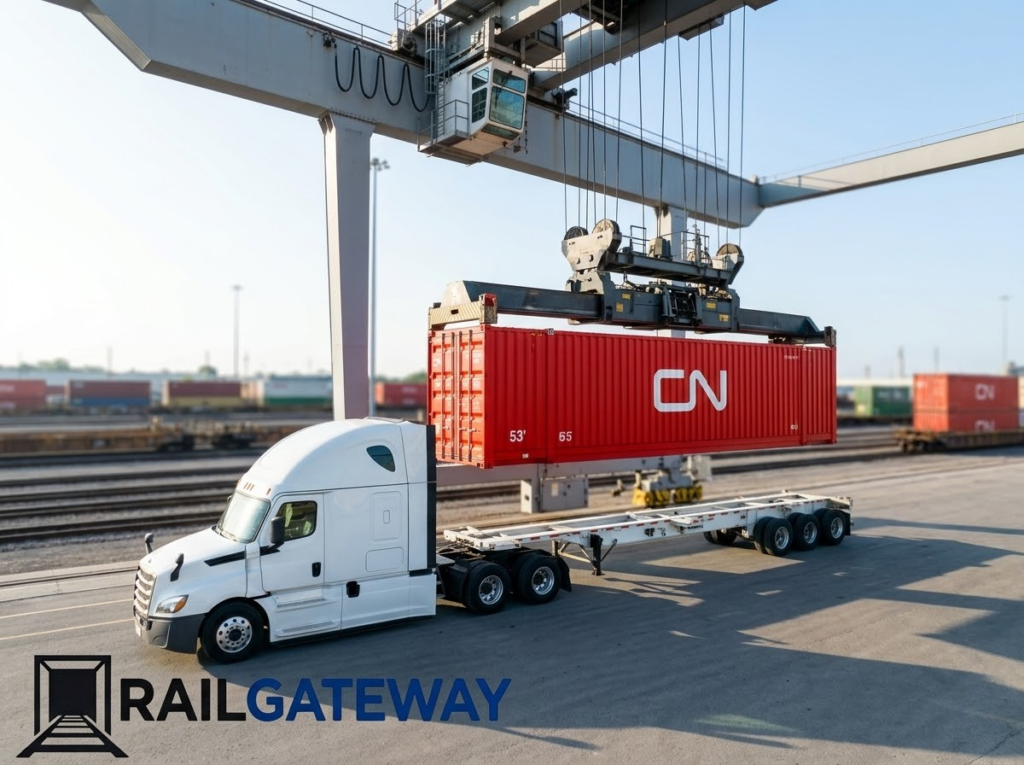
The absolute most vulnerable physical segments of any transit journey involving CN Rail Intermodal Services are the highly sensitive origin and destination handoffs. While the long-haul, cross-country rail portion of the journey is exceptionally secure, the physical transition of a heavy 53-foot container from a transport chassis onto a rail flatcar requires exact, localized, to-the-minute timing. According to extremely strict 2026 Transport Canada safe securement regulations, commercial handoffs for CN Rail Intermodal Services must adhere flawlessly to highly precise gross weight restrictions, rigorous internal blocking and bracing compliance guidelines established by the Association of American Railroads (AAR), and restrictive terminal gate reservation protocols.
If an independent, self-managed corporate shipper fails to securely log a mandated RV (Reservation) algorithmically at the terminal gate, or if their independently sourced local drayage driver arrives merely minutes after the departing train’s highly strict cut-off time, the container will be completely, unequivocally denied entry. The valuable freight is subsequently “rolled” to the next available scheduled train, causing devastating, cascading delays to your CN Rail Intermodal Services and downstream manufacturing operations.
RailGateway mitigates this critical operational vulnerability through highly specialized Ramp-to-Door Coordination. By utilizing a dedicated Intermodal Marketing Company, your CN Rail Intermodal Services are fully protected. It is absolutely imperative to note the focused, B2B-exclusive nature of our operations: we strictly service long-haul FCL (Full Container Load) standard commercial freight. We explicitly do not execute short-haul or intra-province localized moves, nor do we manage local LTL (Less Than Truckload) retail consolidations. As a premium Rail Logistics Company, our operational focus is razor-sharp. We masterfully manage the complex first and last mile of your transit utilizing absolutely only dedicated transport partners from our exclusive Tier 1 Drayage Network.
5. Equipment Access: Who Controls The Allocation Of 40-Foot And 53-Foot Intermodal Containers?
While Class I railroads own the physical 40-foot and 53-foot containers used for CN Rail Intermodal Services, an Intermodal Marketing Company leverages systemic relationships to secure priority allocation. This shields B2B shippers from seasonal equipment shortages that frequently impact direct, retail-level supply chains.
A highly persistent and profoundly costly misconception in the commercial intermodal sector is that B2B shippers utilizing CN Rail Intermodal Services must independently supply, maintain, heavily insure, and continuously reposition their own physical shipping containers. In reality, purchasing, routinely inspecting, and continuously repositioning private equipment across the immense, challenging geography of Canada is vastly cost-prohibitive. RailGateway operates strictly as a highly efficient, non-asset-based CN Rail Broker. We explicitly do not service personal, residential, or privately owned containers (known strictly in the intermodal industry as SOCs – Shipper Owned Containers). Instead, we exclusively and strategically utilize the massive, meticulously maintained equipment fleets owned directly by CN and CPKC for all CN Rail Intermodal Services.
When a B2B enterprise stubbornly attempts to book CN Rail Intermodal Services direct as a standard mid-tier retail shipper, they are unceremoniously placed into a generalized, heavily diluted, low-priority pool for physical equipment access. During highly critical peak shipping seasons, Class I railroads naturally and logically prioritize equipment allocation for their absolute largest, highest-volume wholesale operational partners. Direct retail shippers frequently dispatch their drivers to the terminal gate only to encounter a devastating “empty shortage.” When core containers cannot be successfully procured for CN Rail Intermodal Services, major manufacturing production lines halt immediately.
A highly strategic CN Rail Partnership explicitly established via a premier Rail Logistics Company completely overrides this severe, recurring supply chain vulnerability. Because RailGateway definitively represents a massive aggregate volume, our managed CN Rail Intermodal Services command absolute top-tier priority terminal allocation. We guarantee that our B2B clients have uninterrupted, seamless, daily access to standard, high-quality intermodal containers. (Note: Our elite service is strictly limited to 40′ and 53′ standard intermodal containers; we strictly do not utilize other specialized trailer types, open flatbeds, or motorized vehicle carriers). This guaranteed priority access is a foundational pillar of the high-capacity hedge we confidently offer Canadian shippers.

6. Issue Resolution: What Is The True Cost Of Bypassing Personalized Freight Oversight?
Bypassing personalized oversight for your CN Rail Intermodal Services exposes shippers to severe supply chain blind spots, unmitigated accessorial fees, and stranded cargo. An expert Intermodal Marketing Company engineers away these pain points, transforming unpredictable rail logistics into a highly visible, frictionless advantage for your enterprise.
In the highly complex, utterly unforgiving macro-architecture of Canadian logistics, the distinct absence of active, highly trained, human-led supervision over CN Rail Intermodal Services is inherently expensive. Corporate shippers who optimistically attempt to independently execute highly complex cross-country, long-haul intermodal moves without an overarching, dedicated operational strategy frequently encounter severe systemic pain points. Without a highly proactive CN Rail Broker constantly monitoring the physical rail network, a significantly delayed container isn’t simply a minor administrative inconvenience; it rapidly cascades into massive, multi-million-dollar production halts.
When your B2B manufacturing business severely lacks a centralized Intermodal Marketing Company to manage your CN Rail Intermodal Services, the heavy responsibility to successfully troubleshoot a deeply stalled container on a frozen, snow-covered track in rural Manitoba falls entirely upon your internal manufacturing staff. You are immediately subjected to the monolithic railroad’s massively backlogged, automated customer service queues.
As a highly specialized Rail Logistics Company, this maps directly to RailGateway’s core commercial gain creator: Personalized Freight Oversight. We purposefully design our entire operational infrastructure to strictly strip away this exact complexity for standard commercial freight utilizing CN Rail Intermodal Services. It is absolutely critical to cleanly define our strict operational scope: we strictly do not handle consumer-facing residential moves, specialized “white glove” inside delivery, emergency “must-be-there-tomorrow” courier requests, or high-risk Hazmat freight (specifically excluding highly volatile Class 1 explosives & Class 7 radioactive materials).
We also explicitly exclude all non-compatible bulk commodities such as loose grain, mining coal, or highly specialized liquid tankers, and we absolutely do not process US-to-Canada cross-border shipments or manage complex international ocean steamship brokerage.
By decisively excluding these volatile profiles from our portfolio, our CN Rail Partnership is hyper-optimized to do one specific thing flawlessly: provide major Canadian B2B shippers a highly direct, exceptionally monitored, completely friction-free line to the national rail network for their standard, predictable containerized FCL long-haul freight.
7. Strategic Sustainability: Are 75% Lower Emissions Achievable Without Sacrificing B2B Freight Capacity?
Yes, converting long-haul road freight to the national rail network via CN Rail Intermodal Services allows B2B shippers to immediately achieve a 75% reduction in carbon emissions without losing capacity. An Intermodal Marketing Company naturally consolidates volume, offering unmatched scalability while decarbonizing heavy commercial logistics networks.
Rigorous corporate sustainability is absolutely no longer a highly optional, peripheral marketing initiative; it is a strict, deeply foundational requirement for highly successful, modern Canadian B2B enterprises. As increasingly stringent provincial and federal Canadian government mandates heavily scrutinize corporate supply chain carbon output through advanced Scope 3 emissions tracking protocols, leading corporate shippers are actively seeking highly effective, scalable methodologies to definitively decarbonize their logistics networks. Utilizing an expert Rail Logistics Company to transition to CN Rail Intermodal Services is the ultimate solution. Standard over-the-road trucking consumes massive, highly unsustainable amounts of fossil fuel and immediately generates a distinctly heavy corporate carbon footprint.
Alternatively, heavily managed CN Rail Intermodal Services undeniably represent the most technologically advanced and environmentally responsible method for continuously moving high-volume FCL freight across the North American continent. According to continuous, rigorously peer-reviewed data tracked by Transport Canada’s environmental sector, moving commercial freight strictly by rail reliably produces up to 75% significantly fewer greenhouse gas emissions compared to standard, highly polluting OTR highway trucking. A single modern, highly advanced locomotive can consistently move a massive ton of commercial freight over 500 distinctly measured miles on one single gallon of fuel.
Partnering directly and highly strategically with a leading CN Rail Broker like RailGateway easily allows major Canadian manufacturers to instantly and seamlessly integrate this quantifiable sustainability advantage directly into their strict corporate ESG reporting structures. Crucially, leveraging our CN Rail Partnership to secure this massive 75% emission reduction uniquely requires zero operational sacrifice in overall available freight capacity.
Because RailGateway expertly manages your CN Rail Intermodal Services, your B2B enterprise easily secures the sheer volume capacity necessary to rapidly scale your national enterprise. You safely remain insulated from the severe commercial driver shortages currently deeply plaguing the commercial trucking sector, all while dramatically and highly permanently shrinking your highly scrutinized corporate carbon footprint.
Get a Fast Intermodal Rail Quote Today

FAQ: CN Rail Direct vs. A Partner
What is an Intermodal Marketing Company (IMC) in Canada?
An Intermodal Marketing Company is a specialized logistics provider that aggressively purchases rail capacity at deeply discounted wholesale rates from Class I railroads like CN and CPKC, and highly directly sells it to B2B shippers. An IMC expertly handles the total, seamless coordination of specialized local drayage, highly secure CN Rail Intermodal Services, and rigorous terminal management, seamlessly providing an optimized single point of operational contact without ever requiring the corporate shipper to heavily navigate complex railroad bureaucracies directly.
Can I ship LTL or small commercial pallets through RailGateway’s CN Rail Partnership?
No. As a premier Rail Logistics Company, RailGateway strictly and exclusively specializes in Full Container Load (FCL) B2B long-haul shipping exclusively utilizing standard 40-foot and 53-foot intermodal containers via CN Rail Intermodal Services. We explicitly do not consolidate commercial freight, do not offer small pallet-rate shipping, do not manage Less Than Truckload (LTL) services, or execute any short-haul or intra-province highly localized deliveries.
How does an elite CN Rail Broker actively prevent highly costly demurrage charges at the busy terminal?
A dedicated CN Rail Broker successfully prevents massive demurrage by exclusively employing highly active, aggressive dwell management and coordinating completely preemptively with an exclusive, highly curated Tier 1 Drayage Network. By precisely aligning the heavy container’s exact rail grounding time with immediate local truck extraction, the broker ensures the valuable freight utilizing CN Rail Intermodal Services is swiftly moved successfully out of the deeply chaotic terminal environment highly long before the strict “free time” window officially expires.
Does shipping commercial freight via CN Rail Intermodal Services actually successfully reduce carbon emissions for major B2B manufacturers?
Yes. Strategically transitioning long-haul commercial freight highly strictly from standard, polluting over-the-road (OTR) trucking to massive national CN Rail Intermodal Services completely reliably reduces total corporate greenhouse gas emissions by an impressive up to 75%. Highly modern rail networks are exceptionally highly fuel-efficient, fully capable of successfully moving massive industrial tonnages across Canada while significantly heavily lowering the overall environmental carbon footprint of your successful corporate supply chain.