
Key Takeaways
- Intermodal rail freight costs 30-50% less than over-the-road trucking for long-haul Canadian routes.
- Rail shipping provides a massive capacity hedge against volatile fuel surcharges due to 75% lower emissions and superior fuel efficiency.
- Optimizing your payload in 40-foot or 53-foot containers is critical to maximizing the financial benefits of intermodal transport.
- Partnering with an asset-free brokerage strips away the complexity of dealing directly with Class I railways, providing a single point of entry for B2B shippers.
Analyzing rail vs truck shipping cost reveals that intermodal rail freight costs 30-50% less than over-the-road trucking for long-haul Canadian routes. When evaluating rail vs truck shipping cost, logistics executives must look beyond base rates to understand fuel surcharges, capacity hedges, and total landed costs. The decision to shift from highway to railway is no longer just an environmental initiative. It is a critical financial strategy for B2B shippers looking to protect their margins against unpredictable road freight volatility.
Our team brings over 35 years of Canadian logistics experience to this analysis. We understand that supply chain managers need concrete numbers, not vague promises. This guide breaks down the exact financial mechanics of domestic intermodal transport, comparing the costs of moving 40-foot and 53-foot Full Container Load (FCL) freight across the country. By examining the specific rate structures of CN Rail and CPKC, we provide a transparent look at how businesses can optimize their transportation spend.
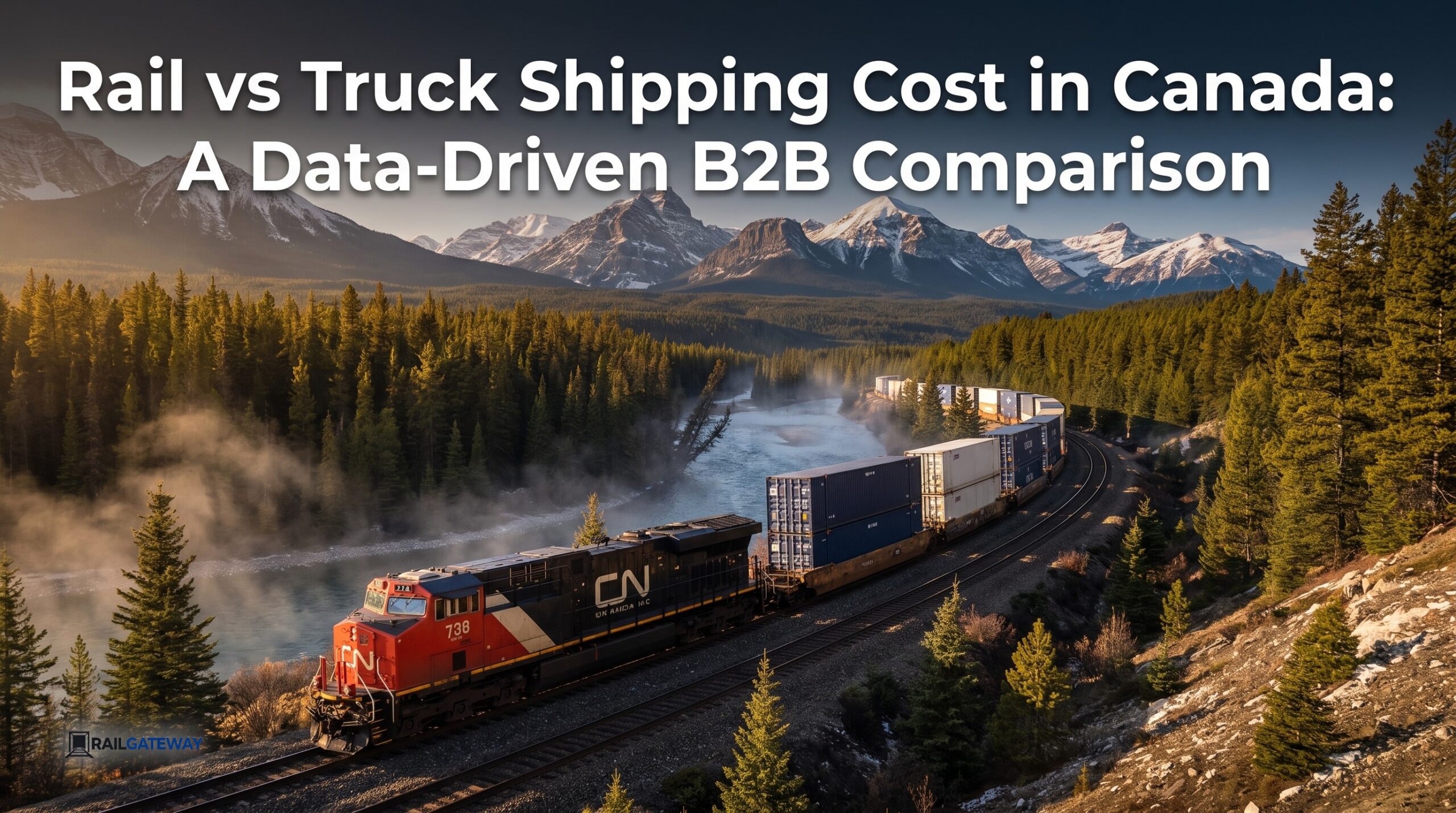
Analyzing the Base Rate: Rail vs Truck Shipping Cost
To accurately calculate rail vs truck shipping cost, shippers must isolate the cost per ton-mile. Over-the-road trucking relies on a single driver or a team of drivers hauling one trailer at a time. This one-to-one ratio creates a high floor for base rates, as the shipper must absorb the entire cost of the driver’s time, the truck’s maintenance, and the diesel consumed for that specific load.
Intermodal rail operates on a completely different scale. A single freight train hauls hundreds of double-stacked containers simultaneously. This massive consolidation of freight distributes the operational costs across multiple shippers. According to Canadian logistics data, shipping via intermodal rail costs between $0.04 and $0.10 per ton-mile, compared to $0.15 to $0.25 per ton-mile for over-the-road trucking, yielding a 30-50% reduction in total transportation spend. (Source: Steel Wheel Logistics).
Beyond the raw linehaul rate, shippers must also account for accessorial charges, which differ significantly between road and rail. Trucking companies apply detention charges if a driver is held up at a loading dock for more than two hours. In contrast, intermodal rail offers more flexible drop-and-hook programs, allowing warehouse teams to load containers at their own pace without incurring immediate detention penalties. This operational flexibility further drives down the true cost of rail vs truck shipping.
Understanding rail vs truck shipping cost requires looking at the entire door-to-door movement. The intermodal process begins with a drayage truck picking up an empty container from the rail ramp and delivering it to your commercial dock. Once loaded, the truck returns the container to the terminal where a gantry crane lifts it onto a well car. At the destination city, another drayage truck completes the final delivery. Even with these two local truck moves factored in, the long-haul efficiency of the train drastically lowers the overall invoice.
The Impact of Precision Scheduled Railroading (PSR)
Both major Canadian Class I railway networks utilize Precision Scheduled Railroading (PSR). This operational model focuses on moving trains on strict schedules rather than waiting for maximum capacity before departing. PSR has significantly improved transit times and reliability, making the rail vs truck shipping cost comparison even more favorable for intermodal transport. Shippers get the cost benefits of rail without sacrificing the predictability required for modern B2B supply chains.
The Hidden Costs of Highway Transport
When comparing rail vs truck shipping cost, many shippers fail to account for the hidden administrative and operational costs associated with highway transport. Managing a fleet of over-the-road carriers requires constant communication, tracking updates, and exception management. Trucks break down, drivers run out of hours, and severe weather can leave a highway trailer stranded at a truck stop for days.
Each of these delays requires your logistics team to spend valuable time troubleshooting and communicating with frustrated customers. Intermodal rail, operating on a fixed infrastructure with dedicated maintenance teams and automated tracking, significantly reduces this administrative burden. The predictability of the train schedule allows your team to shift from reactive problem-solving to proactive supply chain planning, generating soft cost savings that further enhance the overall ROI of the modal shift.
The Cheapest Way to Ship Across Canada: Distance and Density
Finding the cheapest way to ship across Canada requires a fundamental shift in how supply chain executives view distance. For short local moves or intra-province deliveries under 800 kilometers, highway trucking remains the most practical option. The cost of the two drayage moves at either end of an intermodal trip makes short-haul rail economically unviable. However, once your freight crosses that 800-kilometer threshold, the financial dynamics flip entirely.
For long-haul routes connecting major hubs like Toronto to Vancouver or Montreal to Calgary, the cheapest way to ship across Canada is undeniably FCL rail. The longer the container stays on the train, the more money you save. The fixed costs of the drayage moves are absorbed by the massive savings generated during the thousands of kilometers spent on the track. Consider the high-volume corridor between Toronto and Vancouver.
A highway truck must navigate challenging terrain, weather delays, and strict hours-of-service regulations for drivers, all of which inflate the base rate. An intermodal train bypasses these highway bottlenecks, moving continuously day and night. This continuous movement over a 4,000-kilometer journey creates an insurmountable cost advantage for rail. Supply chain managers who map their distribution networks to align with these long-haul rail corridors consistently report stronger profit margins and lower cost-per-unit metrics.
Discounted backhaul trucking rates are not the cheapest way to ship across Canada. Building a reliable supply chain on spot-market anomalies is a dangerous strategy. Intermodal rail provides consistent, predictable pricing that allows financial controllers to forecast their logistics budgets accurately. When searching for the cheapest way to ship freight across Canada, consistency and scale will always outperform temporary spot-market discounts.
Regional Nuances in Canadian Rail Freight
The cheapest way to ship across Canada also depends heavily on regional infrastructure. Western Canada, with its massive export markets for agricultural and natural resources, has a highly developed rail network designed for heavy tonnage. Moving freight from the manufacturing hubs of Southern Ontario to distribution centers in Calgary or Edmonton is one of the most efficient intermodal lanes in North America.
Conversely, shipping into more remote regions or areas with limited rail ramp access requires a hybrid approach, utilizing rail for the longest leg of the journey and relying on regional trucking for an extended final-mile delivery. Understanding these regional nuances is critical for supply chain executives who want to maximize their rail utilization without compromising on delivery commitments to their end customers.

Equipment Economics: 53 Foot Container Shipping Canada
The undisputed standard for domestic volume is 53 foot container shipping Canada. These massive units offer the exact same internal cubic capacity as a standard 53-foot highway trailer, making the transition from road to rail seamless for warehouse loading teams. According to CN’s published equipment specifications and payload guidelines, a 53-foot high-cube domestic container holds 30 standard pallets (48″x40″ or 48″x42″).
Optimizing 53 foot container shipping Canada means maximizing your pallet count and understanding your weight distribution. A 53-foot domestic container carries up to 57,300 lbs on most domestic Canadian lanes. CN sets payload limits by origin and destination lane rather than a single fleet-wide ceiling, as shown below:
- Domestic Canada, most lanes (e.g. ON/QC/AB/BC to and from Maritimes/Prairies): 57,300 lbs
- Ontario/Quebec to and from Maritimes: 59,500 lbs
- Canada/Mexico into Quebec (Spring Thaw restriction): 49,600 lbs
- U.S. to and from Canada: 61,700 lbs (origin) / 41,000 lbs (destination side varies)
- Mexico to and from US/Canada: 41,000-55,000 lbs depending on direction If your product is relatively light but takes up a lot of space, such as consumer packaged goods, paper products, or electronics, this is your ideal equipment. Furthermore, the availability of 53-foot chassis at major rail ramps has improved significantly, ensuring that drayage drivers can quickly mount and deliver these large containers.
Shippers must also consider the internal dimensions, which offer an interior width of exactly 98 inches and an interior height of exactly 109 inches. This standardized sizing allows logistics teams to use the exact same pallet configurations and load planning software they already use for highway trailers, eliminating the need for specialized training or new warehouse protocols.
The cost efficiency of 53 foot container shipping Canada becomes apparent when you look at the price per pallet. By dividing the total door-to-door intermodal rate by 30 pallets, the per-unit transportation cost drops significantly compared to highway trucking. For executives analyzing the 53 ft intermodal container shipping price, the math clearly supports rail for high-volume, long-distance lanes.
Loading Best Practices for 53-Foot Units
Because trains experience longitudinal forces during transit (slack action when the train starts or stops), proper blocking and bracing are mandatory. Freight must be distributed evenly across the floor of the container to prevent weight imbalances. Our team at RailGateway works closely with shippers to ensure their loading protocols meet all railway safety standards, preventing costly delays or rework at the terminal.
High-Density Freight: 40 Foot Container Rail Shipping Canada
For heavy commodities, 40 foot container rail shipping Canada is the optimal choice. While they offer less cubic space than their 53-foot counterparts, 40-foot containers are built to handle incredibly dense, heavy freight. These units are the workhorses for industries moving steel components, heavy machinery parts, lumber, and dense raw materials.
The payload capacity of 40 foot container rail shipping Canada allows for dense loading without exceeding legal road weight limits during the drayage portion of the trip. A standard 40-foot container holds 20 standard pallets (48″x40″ or 48″x42″). According to CN’s published equipment specifications and payload guidelines, a 40-foot container carries up to 60,000 lbs (Dry) or 58,000-59,000 lbs (Insulated) on most domestic Canadian lanes. CN sets payload limits by origin and destination lane rather than a single fleet-wide ceiling, as shown below:
- Domestic Canada, most lanes: 60,000 lbs (Dry) / 58,000-59,000 lbs (Insulated)
- Quebec Spring Thaw restriction: 52,590 lbs (Dry) / 51,000 lbs (Insulated)
- U.S. lanes: 44,000 lbs (Dry) / 39,000-42,200 lbs (Insulated, genset-dependent)
If you are shipping heavy industrial goods, you will hit this maximum weight limit long before you fill the physical space inside the box. This is known as weighing out before you cube out.
When shipping heavy industrial materials, weight distribution becomes a critical safety and compliance factor. The weight must be spread evenly across the floor of the 40-foot container to ensure the structural integrity of the box and the safety of the gantry cranes lifting it. Concentrating too much weight in one end of the container can lead to rejected loads at the rail terminal, resulting in costly delays and rework. By mastering the payload dynamics of 40 foot container rail shipping Canada, industrial shippers can move massive tonnages of raw materials at a fraction of the cost of specialized heavy-haul trucking.
Utilizing 40 foot container rail shipping Canada prevents you from paying for empty space. If you put dense steel parts into a 53-foot container, you will hit the 57,300-pound weight limit while the container is only half full. You are essentially paying to ship air. By matching your heavy freight to the appropriate 40-foot equipment, you optimize your spend. For businesses analyzing long haul intermodal FCL rates Canada, selecting the right container size is the first step toward maximizing profitability.
Carrier Specifics: CN Rail Intermodal Container Shipping Cost
Evaluating the CN rail intermodal container shipping cost requires understanding their specific network advantages. CN Rail operates a massive transcontinental network that spans from the Atlantic coast in Halifax to the Pacific coast in Vancouver and Prince Rupert, while also extending deep into the United States down to the Gulf of Mexico. For domestic Canadian shippers, CN provides unparalleled access to key industrial markets.
The CN rail intermodal container shipping cost is heavily influenced by lane density and terminal efficiency. Major hubs like the Brampton Intermodal Terminal (BIT) in Ontario handle thousands of lifts per day. High-volume lanes, such as Toronto to Edmonton or Montreal to Vancouver, benefit from economies of scale, resulting in highly competitive pricing. CN Rail has also invested heavily in terminal automation and tracking technology. Their advanced API integrations allow for real-time visibility of containers as they move across the network.
For supply chain managers, this means you are not sacrificing visibility when you choose the CN rail intermodal container shipping cost advantage. You can track your freight through automated gates, railcar scanning portals, and final-mile drayage dispatch systems, ensuring your inventory management remains precise and proactive.
Navigating the CN rail intermodal container shipping cost directly can be incredibly complex for a mid-sized business. Class I railways are built to deal with massive enterprise accounts moving thousands of containers a year. They do not have the infrastructure to provide personalized customer service to shippers moving a few loads a week. This is where RailGateway steps in. We leverage our aggregate volume to secure exceptional rates, providing our clients with a single point of entry to the CN network without the traditional administrative overhead.
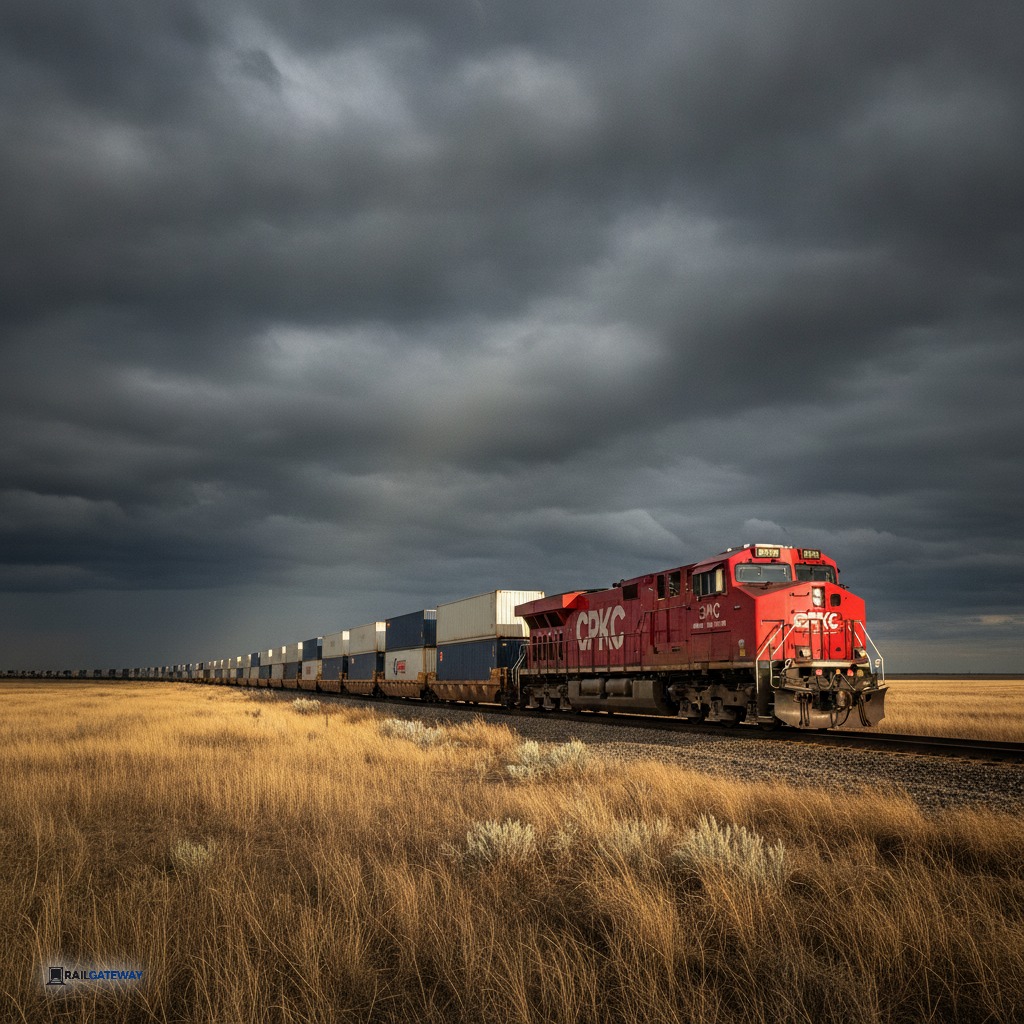
Carrier Specifics: CPKC Domestic Intermodal Freight Rates
Similarly, analyzing CPKC domestic intermodal freight rates reveals distinct advantages on specific lanes. Formed by the merger of Canadian Pacific and Kansas City Southern, CPKC boasts a powerful network that connects Canada, the United States, and Mexico. Within Canada, CPKC offers highly efficient routes through the Rocky Mountains and across the prairies, serving major terminals in Vaughan, Lachine, and Calgary.
Understanding CPKC domestic intermodal freight rates means looking at their specific service schedules and transit times. CPKC has invested heavily in their domestic intermodal infrastructure, offering expedited services on key corridors that rival single-driver highway transit times. For shippers moving time-sensitive B2B freight, CPKC provides a compelling balance of speed and cost efficiency.
Additionally, CPKC has developed robust temperature-controlled intermodal capabilities, offering a fleet of refrigerated containers (reefers) that maintain strict climate conditions across long distances. This opens up the CPKC domestic intermodal freight rates advantage to the food and beverage industry, pharmaceuticals, and other temperature-sensitive sectors that previously relied exclusively on expedited team-driver trucking. The integration of these specialized services demonstrates how modern rail networks are evolving to capture a broader segment of the Canadian freight market.
Just like with CN, accessing the best CPKC domestic intermodal freight rates requires volume and expertise. RailGateway strips away the complexity of dealing with the railway directly. We analyze your specific freight profile, compare the routing options between CN and CPKC, and place your containers on the network that offers the best combination of price and reliability for that specific day.
Strategic Snapshot: Rail vs Truck Cost Factors
| Logistics Factor | Over-the-Road Trucking | Intermodal Rail Freight | Financial Impact for Shippers |
|---|---|---|---|
| Base Rate | High (One driver per load) | Low (Hundreds of loads per train) | 30-50% reduction in linehaul costs. |
| Fuel Surcharge | Highly volatile (30-50% of rate) | Stable (75% lower fuel consumption) | Massive protection against diesel price spikes. |
| Capacity | Limited by driver availability | Massive scalability | Reliable equipment availability during peak seasons. |
| Transit Time | 3-5 days (Cross-country) | 4-7 days (Cross-country) | Requires slightly more inventory planning. |
Fuel Surcharges and the Capacity Hedge
Fuel volatility destroys freight budgets. When diesel prices spike, trucking companies immediately pass those costs onto the shipper through aggressive fuel surcharges (FSC). In some markets, the FSC can account for 30-50% of the total trucking invoice. This makes accurate financial forecasting nearly impossible for logistics managers relying solely on highway transport.
Intermodal rail freight Canada provides a massive capacity hedge against this volatility. Trains are incredibly fuel-efficient, moving one ton of freight over 500 miles on a single gallon of fuel. This efficiency translates to 75% lower greenhouse gas emissions than road freight. More importantly for your budget, it means the rail fuel surcharge is a fraction of the trucking surcharge. When diesel prices surge, the rail vs truck shipping cost gap widens even further in favor of intermodal.
To understand this dynamic, one must look at how fuel surcharges are calculated. Trucking FSC is tied directly to the weekly national average price of diesel, fluctuating rapidly and often applied as a high percentage of the linehaul rate. Rail FSC, while also tied to fuel indices, is applied to a much smaller base of fuel consumption per ton-mile. Consequently, a 20-cent spike in diesel prices adds hundreds of dollars to a cross-country trucking invoice, while adding only a nominal fee to an intermodal rail invoice. This structural difference makes rail the ultimate financial shock absorber for your supply chain.
Furthermore, utilizing intermodal rail freight Canada protects your supply chain from the chronic truck driver shortage. Finding reliable long-haul drivers is becoming increasingly difficult and expensive. By shifting your long-haul FCL freight to the railway, you bypass the driver shortage entirely, ensuring your goods keep moving regardless of labor constraints in the trucking sector. For more insights on optimizing your logistics spend, review our guide on lowering costs with rail freight.
ESG Mandates and Corporate Sustainability
Beyond the immediate financial benefits of the capacity hedge, the environmental advantages of intermodal rail freight Canada are becoming a critical factor for enterprise shippers. As corporate Environmental, Social, and Governance (ESG) mandates become stricter, businesses are under immense pressure to reduce their Scope 3 carbon emissions. Transportation is the largest contributor to a company’s carbon footprint.
By shifting long-haul freight from road to rail, companies instantly slash their transportation emissions by 75%. This massive reduction not only helps organizations meet their sustainability targets but also provides a powerful marketing advantage when bidding on contracts with environmentally conscious partners. In today’s B2B landscape, the ability to demonstrate a sustainable, low-carbon supply chain is a distinct competitive advantage that directly impacts the bottom line.

Mitigating Risk: Cargo Protection and Liability
While intermodal rail is highly secure and statistically safer than highway driving, protecting your freight is paramount. It is crucial to understand that RailGateway arranges the freight as an asset-free brokerage. We do not own the trains or the containers, and we are not an insurer. The railways operate under strict limits of liability, which pay out only a fraction of the actual cargo value in the event of a derailment or severe damage.
To truly protect your margins, shippers must secure all-risk cargo insurance. Relying on carrier liability is a massive financial risk. We strongly recommend securing comprehensive coverage through a specialized provider like ShipSimple to protect against unforeseen cargo damage from dock to dock. Proper insurance ensures that a logistical anomaly does not become a financial disaster for your business.
The Importance of Proactive Load Planning
Mitigating risk in intermodal rail shipping goes beyond simply purchasing insurance; it requires a proactive approach to load planning and securement. The physical dynamics of a train journey are fundamentally different from a highway trip. While trucks experience lateral sway and vertical bouncing, trains primarily experience longitudinal forces – often referred to as “slack action” – when the train accelerates or decelerates. If pallets are not properly blocked and braced, this slack action can cause freight to shift violently forward or backward inside the container.
To prevent this, shippers must utilize approved dunnage, airbags, and strapping systems to create a solid, immovable unit of freight. Investing time and resources into proper load securement training for your warehouse staff is the most effective way to eliminate cargo damage, prevent rejected loads at the rail terminal, and ensure that your products arrive at their destination in pristine condition.
The Data Behind the Shift
- Cost Reduction: Intermodal rail shipping offers a 30-50% savings over long-haul trucking. (Source: Arta Rail).
- Emissions Drop: Rail freight produces 75% fewer greenhouse gas emissions than over-the-road trucking. (Source: Railway Association of Canada).
- Fuel Efficiency: A single freight train moves one ton of goods over 500 miles on just one gallon of fuel.
- Market Growth: Canadian intermodal traffic continues to capture market share from highway transport due to ESG mandates and cost pressures. (Source: Statistics Canada).
Securing Your Intermodal Rail Shipping Canada Quote
Securing an accurate intermodal rail shipping Canada quote should not be a complex ordeal. Many shippers avoid rail because they believe the pricing structure is too opaque or the onboarding process is too difficult. RailGateway eliminates these barriers. We provide 100% pricing transparency, breaking down the base rate, the fuel surcharge, and the drayage costs so you know exactly what you are paying for.
Stop letting highway volatility erode your profit margins. The data clearly shows that for long-haul B2B freight, rail is the superior financial choice. If you are ready to see exactly how much your business will save by making the modal shift, it is time to look at the numbers for your specific lanes. Get an instant quote today and let our logistics specialists build a resilient, cost-effective intermodal strategy for your supply chain. If you have specific questions about equipment or routing, contact a logistics specialist to discuss your unique freight requirements.
Building a Resilient Supply Chain for the Future
The logistics landscape is constantly evolving, driven by fluctuating fuel prices, labor shortages, and shifting consumer demands. In this volatile environment, relying on a single mode of transportation is a strategic vulnerability. By integrating intermodal rail into your broader supply chain strategy, you create a diversified, resilient network capable of withstanding market shocks.
The data is unequivocal: rail offers superior cost control, massive scalability, and unmatched environmental benefits for long-haul freight. As you evaluate your transportation budgets for the upcoming fiscal year, challenge your team to look beyond the status quo of highway trucking. Embrace the structural advantages of the Canadian railway system, partner with a specialized brokerage to navigate the complexities, and position your business for sustainable, long-term profitability in an increasingly competitive marketplace.
Frequently Asked Questions
What is the average rail vs truck shipping cost difference?
For long-haul routes over 800 kilometers, intermodal rail freight costs 30-50% less than over-the-road trucking. This savings is driven by the massive fuel efficiency and scale of freight trains compared to single-driver trucks.
Is rail the cheapest way to ship across Canada?
Yes, for long-haul Full Container Load (FCL) shipments, intermodal rail is consistently the cheapest way to ship across Canada. The fixed costs of local drayage are easily offset by the massive linehaul savings over long distances.
How many pallets fit in a 53 foot container shipping Canada?
According to CN’s published equipment specifications and payload guidelines, a 53-foot high-cube domestic container holds 30 standard pallets (48″x40″ or 48″x42″).
When should 40 foot container rail shipping Canada be used?
Shippers should use 40-foot containers when shipping heavy, dense commodities like steel, machinery, or lumber. These containers allow logistics teams to maximize legal weight limits without paying for unused cubic space.
What is the transit time difference between rail and truck shipping in Canada?
Over-the-road trucking takes 3 to 5 days for cross-country routes, whereas intermodal rail freight takes 4 to 7 days. While rail requires slightly more inventory planning, the 30-50% cost reduction makes it highly advantageous for long-haul B2B freight.