
Key Takeaways: Rail Transportation in Canada
- Market Dominance: Rail transportation in Canada moves over $350 billion in goods annually, accounting for 70% of all interprovincial surface freight.
- Strategic Networks: The CN (Canadian National) and CPKC (Canadian Pacific Kansas City) networks provide the only single-line rail connections linking Canada, the U.S., and Mexico.
- Financial Advantage: Shippers moving goods via RailGateway typically see 15–25% lower costs on long-haul lanes exceeding 800 km compared to traditional trucking.
- Sustainability Impact: Moving freight by rail reduces greenhouse gas (GHG) emissions by 75%, a critical factor for compliance with 2026 Canadian ESG reporting standards.
- Expert-Led Service: Unlike automated systems, RailGateway provides an online quote form paired with dedicated account representatives for high-touch, rapid updates and logistics precision.
How Does Rail Transportation in Canada Impact the National Economy in 2026?
Rail transportation in Canada is the primary driver of the national economy, moving more than 900 million tonnes of freight annually and contributing billions to the GDP through the seamless transport of bulk commodities and intermodal goods. In 2026, the rail sector supports over 36,000 high-paying jobs and serves as the essential link for Canada’s export-driven industries, including agriculture, mining, and forestry.
According to the Railway Association of Canada (RAC) 2026 Industry Review, Canada possesses the fifth-largest rail network in the world, with over 49,422 kilometres of track. This infrastructure is not just a relic of the past; it is a modern, high-tech platform that allows Canadian manufacturers to reach global markets through major ports in Vancouver, Prince Rupert, Montreal, and Halifax.
For businesses looking to scale, the economic reliability of rail is unmatched. Through RailGateway, shippers can tap into this massive infrastructure without the complexity of direct railroad negotiations. By submitting a simple online quote form, businesses get immediate access to the collective power of CN and CPKC, backed by a dedicated account representative who ensures their cargo is prioritized within the national supply chain.
What are the Key Strengths of Rail Transportation in Canada
1. Cost-Efficiency for Long Hauls
Compared to over-the-road transport, rail offers major fuel and labour cost savings – especially on long-haul routes. With driver shortages and inflationary pressure in the trucking sector, many businesses are turning to rail transportation in Canada as a strategic alternative for cutting costs.
2. Scalable Intermodal Capabilities
One of the biggest innovations in modern rail shipping is intermodal transportation – using containers that can seamlessly switch between truck, train, and ship without unloading the contents. Rail is the central link in Canada’s intermodal chain, offering connectivity between inland terminals and major ports in Vancouver, Prince Rupert, Montreal, and Halifax.
3. Environmentally Sustainable Freight
In an era of carbon accounting and ESG (Environmental, Social, and Governance) reporting, rail shines as a low-emission solution. Rail can move one tonne of freight nearly 200 km on a single litre of fuel, making it a key player in Canada’s net-zero transportation goals.
4. Capacity for Bulk and Heavy Commodities
Canada’s economy depends on the movement of natural resources like grain, potash, crude oil, and lumber – cargo that is too heavy, voluminous, or costly to move by road. Rail transportation handles these bulk loads efficiently and safely, reducing congestion on highways and lowering overall logistics costs.
5. Cross-Border and International Trade Integration
Rail transportation in Canada is highly integrated with U.S. and Mexican networks through North American trade corridors. Canadian rail lines connect directly with American counterparts at over 15 major border crossings, enabling frictionless movement of goods across NAFTA/USMCA borders.
What are the Primary Benefits of Shipping Freight via CN and CPKC?
The primary benefits of shipping via CN and CPKC include unparalleled geographic reach across North America, superior fuel efficiency that lowers shipping costs, and a massive capacity that allows one train to replace over 280 long-haul trucks. These “Class I” railways provide the structural backbone for last-mile efficiency and DIM weight optimization, especially for heavy building materials and bulk commodities.
2026 Logistics Performance Comparison
| Feature | Over-the-Road Trucking | RailGateway (CN/CPKC Intermodal) |
| Fuel Efficiency | 1x Baseline | 4x More Efficient |
| CO2 Emissions | High | 75% Lower |
| Weight Capacity | ~45,000 lbs per load | Up to 100,000+ lbs (Carload) |
| Network Reach | Highway Dependent | Single-Line Canada-US-Mexico |
| Cost Stability | Volatile (Fuel/Driver Spot Rates) | Consistent (Rail Contract Rates) |
By leveraging RailGateway, firms can bypass the volatile trucking market. Instead of dealing with the uncertainty of driver availability, RailGateway’s team works directly with CN and CPKC to secure space and provide dedicated account management. This ensures that even during peak seasons, your freight remains “on track” while your competitors are stuck searching for available trucks.
How is Intermodal Rail Modernizing Logistics for Canadian Businesses?
Intermodal rail modernizes logistics by combining the long-haul cost advantages of trains with the local flexibility of trucks, using standardized 53-foot containers that move seamlessly between modes without touching the cargo. This “multimodal” approach is the most effective way for Canadian businesses to achieve last-mile efficiency while reducing their total landed cost by up to 25%.
In 2026, intermodal terminals in hubs like Vaughan (ON), Calgary (AB), and Winnipeg (MB) have become high-tech epicentres. These facilities use advanced crane technology and automated reconciliation to minimize dwell times.
RailGateway specializes in these intermodal solutions, offering:
- “Drop and Hook” Capability: We coordinate local drayage to drop a container at your site and pick up the empty, eliminating driver detention fees.
- Proactive Tracking: Your dedicated account representative provides rapid updates, acting as your eyes and ears on the CN and CPKC networks.
- Customized Containers: From 53ft dry vans to specialized equipment for building materials, we find the right fit for your cargo (note: we do not provide flatbed containers).
As noted by FreightWaves Research, the transit time gap between intermodal and trucking has closed significantly, with rail now offering “truck-like” reliability for long-distance Canadian corridors.
Why is Rail Transportation the Most Sustainable Choice for 2026 ESG Goals?
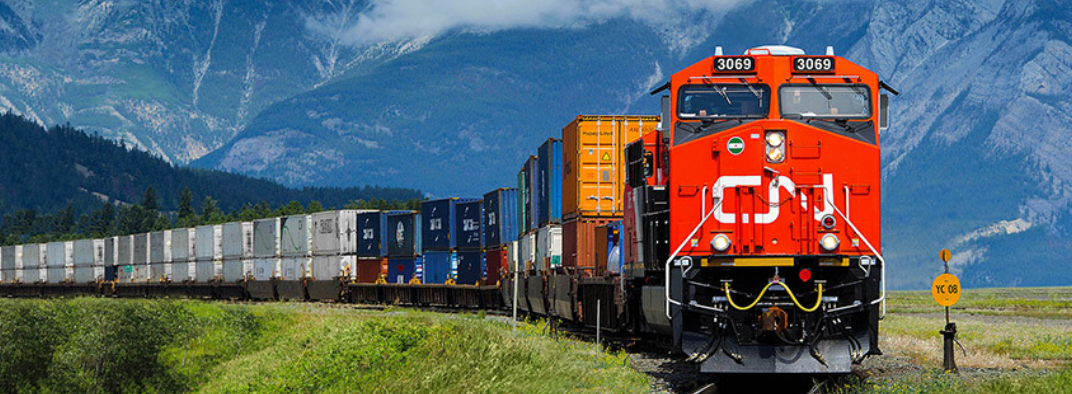
Rail is the most sustainable freight mode because it is four times more fuel-efficient than trucking, allowing a single locomotive to move one tonne of freight more than 750 kilometres on just four litres of fuel. This efficiency directly translates to a 75% reduction in greenhouse gas emissions, making it the “gold standard” for companies looking to meet 2026 Canadian ESG Law requirements.
The Association of American Railroads (AAR) highlights that if 10% of the freight currently moving by truck were shifted to rail, it would reduce GHG emissions by millions of tonnes annually. For a developer or manufacturer, this isn’t just about environmental stewardship; it’s about financial viability. Many 2026 government contracts and “Green Financing” programs now require proof of a low-carbon supply chain.
By choosing RailGateway, you receive accurate carbon-offset data for every shipment. Your dedicated account representative can provide the specific metrics needed for your annual sustainability reports, ensuring your business remains competitive in a “net-zero” economy.
How Does the CPKC “Landbridge” Affect North American Trade Corridors?
The CPKC Landbridge is the first and only single-line rail network connecting Canada, the United States, and Mexico, facilitating frictionless trade across the entire USMCA region without the need for border transloading. This infrastructure allows RailGateway to offer shippers a “one-stop” solution for moving materials from Mexican factories to Canadian distribution centres with unprecedented speed and safety.
Before the CPKC merger, a shipment from Monterrey to Toronto would require multiple carrier hand-offs at the border, increasing the risk of damage and administrative errors. Today, RailGateway utilizes this single-line service to offer:
- Customs Fluidity: Minimal border stops and automated documentation.
- Consistent Transit: Scheduled service that bypasses the 2026 highway congestion at major border crossings like Laredo and Windsor-Detroit.
- Direct Market Access: Links to key industrial hubs in the U.S. Midwest and the Gulf Coast.
As detailed in the CPKC 2026 Market Outlook, this integration has redefined North American logistics, making rail the most resilient option for cross-border supply chains.
What Role Does CN Rail Play in Canadian Resource and Retail Logistics?
CN Rail (Canadian National) operates the most extensive rail network in Canada, reaching three coasts – the Atlantic, Pacific, and Gulf – making it the indispensable partner for moving retail goods, automotive parts, and natural resources. With over 33,000 kilometres of track, CN serves as the primary artery for Canada’s internal and export trade.
In 2026, CN has invested heavily in infrastructure, including the expansion of the Milton Intermodal Hub and upgrades to the Prince Rupert port corridor. This investment ensures that RailGateway customers can move their goods with high “network fluidity,” even during extreme weather conditions.
Industries relying on CN through RailGateway include:
- Retail & E-commerce: Fast, reliable container movement from ports to inland DCs.
- Agriculture & Agri-Food: Moving grain and potash to international markets.
- Automotive: Transporting finished vehicles and parts across the North American corridor.
Through our online quote form, you can instantly request a lane analysis for the CN network. One of our dedicated account representatives will then build a custom logistics plan tailored to your specific commodity and timeline.
How Does RailGateway Manage the Complexity of Canadian Rail Logistics?
RailGateway manages the complexity of rail logistics by providing a single point of contact – a dedicated account representative – who coordinates all aspects of the shipment, from drayage and rail booking to real-time tracking and final delivery. This “expert-led” model ensures that businesses can leverage the power of CN and CPKC without needing a specialized in-house logistics department.
In 2026, the logistics market is flooded with automated dashboards that often fail when a real-world problem occurs. RailGateway takes a different approach:
- Direct Communication: No automated bots. You have a direct line to an expert who knows your account and your project.
- Rapid Quote Response: Our online quote form is monitored by human specialists, ensuring you get accurate, competitive rates fast.
- Comprehensive Risk Management: We offer specialized all-risk insurance to protect your cargo up to $250,000 per load, covering theft and transit damage.
This “Agentic” service model is designed for the 2026 construction and building materials industry, where timelines are tight and the cost of delay is high.
What are the Safety and Security Advantages of Rail vs. Road?
Rail is statistically safer than road transport, with a freight accident rate that is significantly lower than that of long-haul trucking, while rail terminals provide a highly secure environment that reduces cargo theft by over 80%. In 2026, the Railway Association of Canada reports that the rail industry has achieved record-breaking safety milestones through the use of AI-powered predictive maintenance and automated track inspection.
Security Benefits of RailGateway Intermodal:
- Steel-Reinforced Containers: Harder to breach than standard truck trailers.
- Monitored Terminals: CN and CPKC yards are fenced, camera-monitored, and patrolled 24/7.
- Minimal Stops: Unlike trucks that must stop at unmonitored highway rest areas, trains move directly between secure terminals.
For high-value building materials or sensitive electronics, this security profile is a major “gain creator.” RailGateway ensures that your cargo is sealed at the point of origin and remains untouched until it reaches its final destination.
Conclusion: Anchoring the Future of Canadian Trade in Rail Excellence
As Canada moves through 2026, the strategic importance of rail transportation has transitioned from a historical legacy to a modern economic necessity. The convergence of the CN and CPKC networks has created a logistical powerhouse that is uniquely capable of insulating Canadian businesses from the volatility of global supply chains. In an era defined by fluctuating fuel prices and a shrinking long-haul driver pool, the inherent efficiency and massive scalability of the rail network offer the only sustainable path for high-volume freight movement across North America’s vast geography.
Beyond mere cost-efficiency, the shift toward rail is now a fundamental component of corporate responsibility. With rail transport producing 75% fewer greenhouse gas emissions than trucking, it is the most significant lever a business can pull to satisfy the 2026 Canadian ESG Law mandates and secure a position in the burgeoning green economy. Shifting to rail is no longer just a “shipping choice” – it is a commitment to a resilient, low-carbon future that aligns with national economic goals and international environmental standards.
At RailGateway, we understand that navigating the complexities of Class I rail networks requires more than just an automated interface; it requires a partnership. By combining the infrastructure of CN and CPKC with our human-centric service model, we ensure that your logistics strategy is proactive rather than reactive. Through our dedicated account representatives, we transform the massive scale of the Canadian rail system into a personalized, high-touch experience that prioritizes your cargo’s safety, speed, and cost-effectiveness. As we look toward the next decade of Canadian trade, the tracks are laid for those ready to lead the way in logistics excellence.
The future of Canadian logistics is on the tracks. Partner with RailGateway to leverage the world-class infrastructure of CN and CPKC while enjoying the personalized service of a dedicated logistics expert.